
Taper Protocol for Endurance Events: How to Peak Without Losing Fitness

You’ve put in the months of grueling training, logged countless miles, and built a solid aerobic base. Now, with your big race just weeks away, the hardest part begins: backing off. For many endurance athletes, the taper protocol endurance phase feels counterintuitive—even scary. The fear of losing fitness haunts every skipped workout and shortened run. But here’s the truth: a well-executed taper protocol can improve your race-day performance by 2-6%, according to multiple scientific studies. That’s the difference between a personal best and just another finish time.
Understanding the Endurance Taper: What It Is and Why It Works
An endurance taper isn’t simply resting before a race—it’s a strategic reduction in training volume designed to maximize physiological adaptations while eliminating accumulated fatigue. Think of it as the final tuning before a championship performance.
The science behind tapering for endurance athletes is compelling. During this period, your body undergoes several critical physiological changes: muscle glycogen stores increase by 15-20% through glycogen supercompensation, micro-tears in muscle fibers complete their repair process, your central nervous system recovers from training stress, and inflammation markers drop significantly. Research published in the International Journal of Sports Medicine demonstrates that properly executed tapers can yield performance improvements ranging from 2-6%—that’s roughly 6-18 minutes off a marathon time for a 3-hour runner.
Here’s the crucial distinction: strategic tapering differs fundamentally from complete rest. A proper taper protocol maintains training intensity while dramatically reducing volume. This approach preserves your hard-earned aerobic adaptations and neuromuscular sharpness while allowing recovery to occur. Complete rest, conversely, can lead to detraining—loss of mitochondrial density, reduced stroke volume, and decreased lactate threshold. Understanding this helps you recognize what you might be experiencing during your taper. If you’ve been following a structured program including concurrent training, your taper should address both endurance and strength components appropriately.
Common myths persist: “I’ll lose fitness if I don’t train hard,” or “I need one last big workout to prove I’m ready.” Both are counterproductive. Your fitness is already built—the taper simply reveals it by stripping away fatigue.
Designing Your Optimal Taper Protocol for Peak Performance
Creating an effective taper strategy endurance requires precision. The goal is finding that sweet spot where fatigue dissipates but fitness remains intact. This section breaks down exactly how to taper for marathon without losing fitness and provides frameworks for other distances too.
Taper Duration and Volume Reduction Guidelines
The optimal taper duration varies significantly based on race distance and individual training volume. Here’s what research and coaching experience suggest:
- 5K-10K events: 4-7 days with 20-30% volume reduction
- Half marathon: 7-10 days with 30-40% volume reduction
- Marathon: 14-21 days with 40-60% volume reduction
- Ironman/Ultra events: 21-28 days with progressive reduction up to 60%
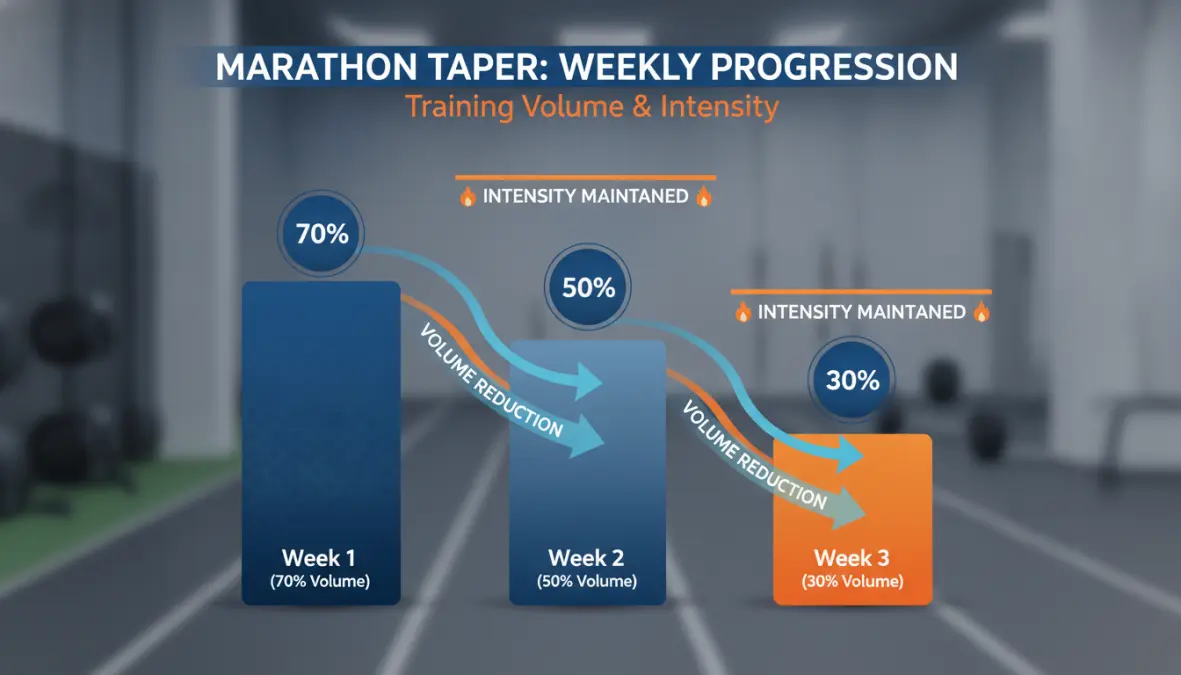
For the best taper protocol for ironman or marathon, consider a progressive approach. Week 1 of your taper reduces volume by 20-25%, week 2 by 40-50%, and the final race week drops to just 30-40% of normal volume. This gradual reduction prevents the shock of sudden inactivity while providing ample recovery time.
A practical example for how long to taper before endurance event like a marathon: if you’ve been running 50 miles weekly, drop to 40 miles three weeks out, 25-30 miles two weeks out, and just 15-20 miles race week (including the race itself). The key principle: reduce duration of runs, not their quality.
Maintaining Intensity While Reducing Training Load
This is where most athletes get it wrong. Your taper week training plan endurance must preserve intensity—those race-pace touches and short intervals that keep your neuromuscular system firing. What changes is volume and frequency.
During your pre-race taper, continue including quality sessions but make them shorter. Instead of 8x800m intervals, do 4x800m. Replace your 90-minute tempo run with 30 minutes at race pace. These “neuromuscular activation” sessions remind your body what race intensity feels like without accumulating fatigue. If you’ve been monitoring your performance using VO2 max and lactate threshold testing, your taper should maintain efforts at these intensities, just briefer.
A sample race week strategy for marathon runners might look like: Monday—easy 30 minutes, Tuesday—20 minutes with 3×3 minutes at race pace, Wednesday—complete rest or 20 minutes very easy, Thursday—15 minutes easy with 4x100m strides, Friday—complete rest, Saturday—10-15 minute shakeout with 2-3 minutes race pace, Sunday—race day. Notice how intensity appears throughout but volume is minimal.

Common Taper Mistakes and How to Avoid Fitness Loss
Even experienced athletes fall into taper traps. Understanding these pitfalls helps you execute a flawless peak performance taper.
The most common mistake? Panic training. You feel fresh mid-taper and convince yourself you need “one more hard workout.” Resist this urge. That freshness is your body signaling it’s ready—adding stress now only compromises race day. Similarly, some athletes reduce volume too early, starting their taper a month out when two weeks would suffice, leading to actual detraining prevention becoming necessary.
Another error is eliminating intensity completely. Remember: volume drops, intensity stays. Cutting all quality work makes you feel sluggish and slow on race day. Your body needs reminders of what race effort feels like. Conversely, some athletes maintain too much volume, essentially just taking a recovery week rather than a proper taper.
The psychological challenge of “taper tantrums” is real. You might feel irritable, anxious, or convinced you’re losing fitness. These feelings are normal—your body is adapting to reduced training stimulus. How do you know if you’re tapering correctly versus actually losing form? Look for these positive indicators: legs feeling springy and fresh, improved sleep quality, slight weight gain (1-2 pounds from glycogen and water storage), increased appetite, and feeling “antsy” to race.
Support elements matter too. Your pre-competition preparation should include strategic nutrition—increasing carbohydrate intake during the final 2-3 days supports that glycogen supercompensation we discussed. Don’t neglect proper hydration strategies during this period. Stress management is equally crucial; extra rest time can lead to overthinking. Keep your routine consistent—same sleep schedule, similar meal times, familiar foods.
For athletes following a comprehensive periodization approach throughout their training cycle, the taper represents the culmination of your build-up phases. Everything from your base building to your zone-based training has prepared you for this moment.
FAQ: Taper Protocol for Endurance Athletes
How long should I taper before an endurance event?
Taper duration depends on race distance: 4-7 days for 5K-10K, 7-10 days for half marathon, 14-21 days for marathon, and up to 28 days for Ironman or ultra events. Longer races require longer tapers due to greater accumulated fatigue from training volume.
Will I lose fitness during a taper?
No, if done correctly. Research shows you can maintain fitness for 3-4 weeks with significantly reduced volume as long as you preserve intensity. Your aerobic adaptations, muscle strength, and neuromuscular efficiency remain intact when you include short, intense efforts during the taper period.
Should I completely rest before a race?
Absolutely not. Complete rest leads to feeling sluggish and can cause actual detraining. Instead, reduce volume by 40-60% while maintaining some intensity. Even race week should include easy runs with brief race-pace efforts and activation strides to keep your system primed.
What is the best taper for a marathon?
A 14-21 day progressive taper works best for most marathoners. Reduce weekly volume by 20-25% in week one, 40-50% in week two, and maintain just 30-40% of normal volume race week. Keep at least two quality sessions (shortened) in weeks one and two, with one brief race-pace touch race week.
The taper protocol endurance phase is where champions are made—not through additional suffering, but through intelligent recovery adaptation. Trust the process, resist the urge to do more, and let your body reveal the fitness you’ve built. Your months of training have prepared you; now give yourself permission to arrive at the start line fresh, sharp, and ready to perform at your absolute best. The taper isn’t about losing fitness—it’s about finally unleashing it.