Nordic Walking Technique: Complete Guide to Full-Body Cardio Workout

Picture this: you’re gliding through a peaceful trail, poles clicking rhythmically against the ground, your entire body engaged in a powerful cardio session that burns calories like crazy without wrecking your joints. That’s the magic of nordic walking technique—a deceptively simple activity that transforms ordinary walking into an incredibly effective full-body workout. Whether you’re a fitness newbie looking for a low impact workout or an athlete seeking quality endurance training, mastering this Scandinavian-born technique might be your game-changer.
What Is Nordic Walking and Why It’s the Ultimate Full-Body Workout
Nordic walking originated in Finland as an off-season training method for cross-country skiers, and it’s evolved into a phenomenal cardiovascular exercise that’s taking the fitness world by storm. Unlike regular walking, nordic walking technique involves using specially designed nordic walking poles to propel yourself forward, actively engaging your arms, shoulders, chest, and core with every stride.
Here’s where things get interesting: nordic walking vs regular walking isn’t even a fair comparison. While regular walking activates roughly 40% of your body’s muscles (primarily your legs), nordic walking engages approximately 90% of your muscle groups. This massive upper body engagement translates into serious nordic walking benefits—you’ll burn up to 46% more calories than traditional walking at the same pace, improve your posture alignment, and boost your cardiovascular fitness without the joint-pounding impact of running.
The full body workout walking approach means you’re essentially getting strength training and cardio simultaneously. Your triceps push against the poles with each stride, your core stabilizes the rotational movement, and your legs power through an extended walking stride. Studies show that nordic walkers can burn between 400-600 calories per hour depending on intensity—significantly more than the 280-350 calories burned during regular walking. Plus, the technique naturally improves circulation to the upper body, making it an excellent choice for anyone concerned about cardiovascular health.
Mastering Proper Nordic Walking Technique
Learning proper nordic walking form isn’t rocket science, but it does require attention to detail. Many beginners wonder how to use nordic walking poles correctly, and the answer lies in understanding the natural walking pattern your body already knows. The key is coordination: when your right foot steps forward, your left arm (holding the pole) swings forward simultaneously, and vice versa. This opposite arm-leg movement creates a smooth, rhythmic flow that feels natural once you get the hang of it.
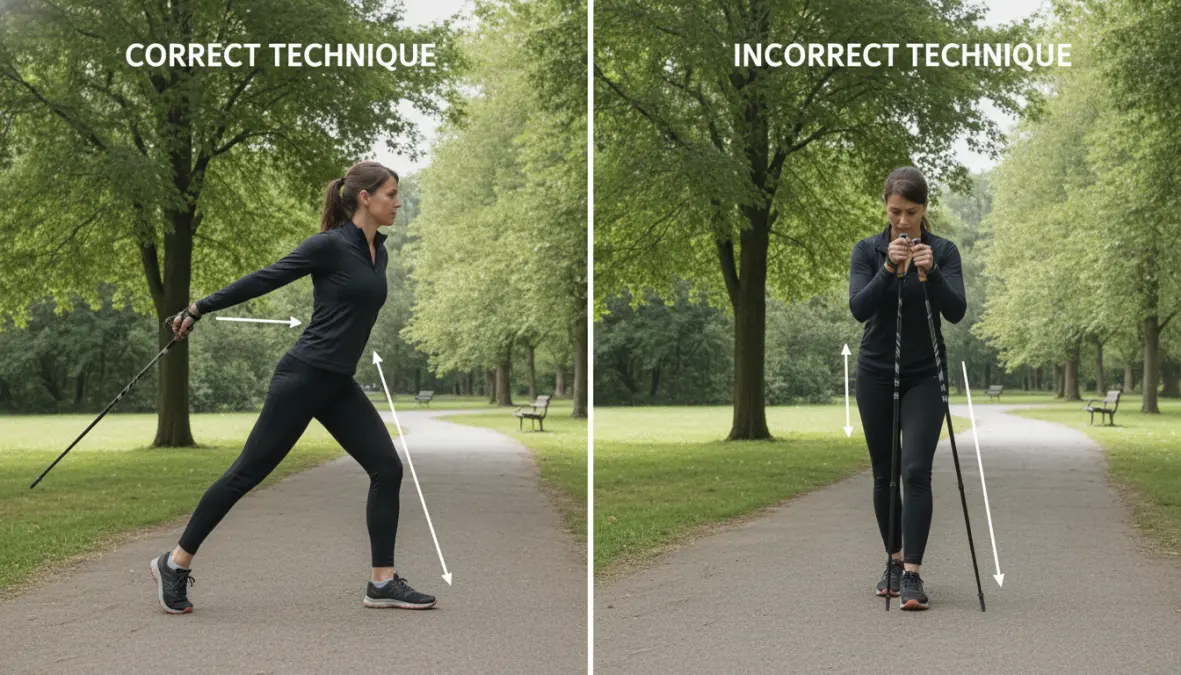
Let’s break down the best nordic walking technique for beginners step-by-step. First, stand tall with relaxed shoulders and a slight forward lean from your ankles (not your waist). Your poles should angle backward at roughly 60 degrees. As you step forward with your right foot, plant your left pole at about the middle of your right foot, not ahead of it. The pole should hit the ground at an angle, never vertically. Push firmly backward through the pole as your arm extends behind you, then release your grip slightly at the end of the push—this is crucial for proper arm swing for nordic walking and prevents hand fatigue.
The common nordic walking mistakes to avoid include keeping your arms too rigid (they should swing naturally from the shoulder), planting poles too far ahead (which creates a braking effect), and failing to fully extend your arm backward during the push phase. Another frequent error is tensing up—nordic walking training should feel fluid and relaxed. Your torso should rotate slightly with each step, creating a gentle twisting motion that engages your obliques and lower back muscles. Think of it as a walking meditation where rhythm matters more than speed.
For those wondering how to improve nordic walking form, practice makes perfect. Start slowly, focusing on one element at a time: first master the arm-leg coordination, then add the pole push, finally incorporate the torso rotation. If you’re interested in building comprehensive fitness beyond just nordic walking, check out our guide on Functional Training vs Traditional Gym to understand how different workout styles complement each other.
Choosing and Using Nordic Walking Poles Correctly
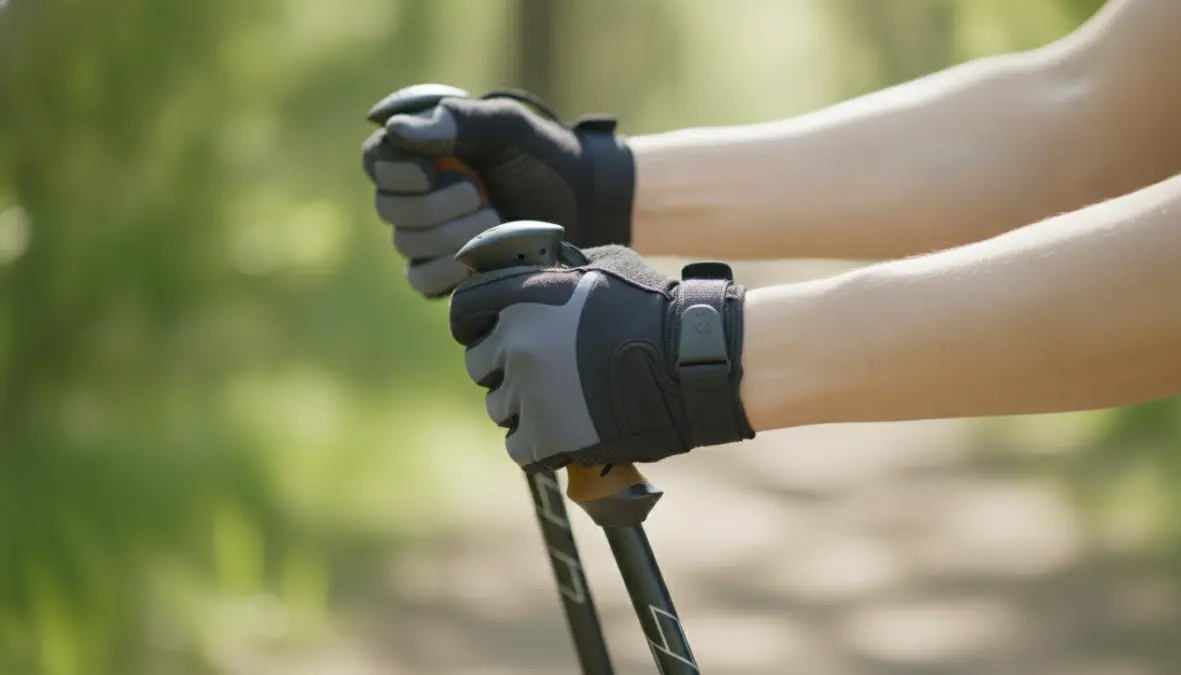
Not all nordic walking poles are created equal, and using the wrong equipment can sabotage your technique. Unlike trekking poles designed for stability on rough terrain, nordic walking poles feature special straps (called gloves or cuffs) that attach around your hand and wrist, allowing you to release your grip during the push-off phase without dropping the pole. This design is essential for the proper pushing motion that makes nordic walking so effective.
The golden rule for pole length: multiply your height in centimeters by 0.68 (or your height in inches by 0.68 and convert). For example, if you’re 170cm tall, your ideal pole length is approximately 115cm. Most quality poles are adjustable, which is perfect for beginners still experimenting with their form. Materials matter too—aluminum poles are affordable and durable, while carbon fiber options are lighter but pricier. The tips should have removable rubber paws for pavement and metal spikes for trails.
Progressive Training Plan for Beginners
The nordic walking technique step by step guide for nordic walking for beginners should be gradual. Week 1-2: Simply walk your normal route carrying the poles, letting them drag behind you to get used to the weight and feel. Don’t worry about technique yet—just build comfort. Week 3-4: Begin implementing the arm swing and opposite arm-leg coordination without focusing on the push. Walk for 20-30 minutes, 3-4 times weekly.
By week 5-6, start adding the backward push and full arm extension. Gradually increase session duration to 45-60 minutes as your endurance builds. Like any new skill, your body needs time to adapt—just as proper nutrition supports adaptation, proper technique supports progress. For optimal recovery between sessions, our Recovery Nutrition guide offers excellent advice on refueling after workouts. The benefits of proper nordic walking technique multiply when you’re consistent, so aim for at least three sessions weekly to see real improvements in fitness and form.
Frequently Asked Questions About Nordic Walking
How many calories does nordic walking burn?
Nordic walking burns approximately 400-600 calories per hour depending on your weight, pace, and terrain—that’s 20-46% more than regular walking at the same speed. The increased calorie burning comes from engaging your upper body muscles throughout the workout.
Is nordic walking suitable for all fitness levels?
Absolutely! Nordic walking for beginners is incredibly accessible because you control the intensity. It’s a perfect low impact workout for seniors, people recovering from injuries, or those with joint concerns, yet challenging enough for serious athletes when performed at higher intensities on varied terrain.
What muscles does nordic walking work?
Nordic walking engages roughly 90% of your body’s muscles, including legs (quadriceps, hamstrings, calves, glutes), upper body (deltoids, triceps, biceps, pectorals, latissimus dorsi), and core (abdominals, obliques, lower back). This comprehensive what muscles does nordic walking work answer explains why it’s such an effective full-body workout.
Can nordic walking help with back pain?
Yes! The technique promotes excellent posture alignment and strengthens core and back muscles, which often alleviates chronic lower back pain. The poles also reduce impact forces on the spine. However, if you have existing back issues, consult your healthcare provider before starting. For complementary approaches to joint health, explore our guide on Anti-Inflammatory Foods for Athletes.
How often should I practice nordic walking?
For general fitness and cardiovascular exercise benefits, aim for 3-5 sessions weekly, each lasting 30-60 minutes. If you’re training for endurance or weight loss, 5-6 sessions work well. Always include at least one rest day for recovery, and consider varying your intensity throughout the week.
Nordic walking proves that sometimes the simplest modifications create the biggest impact. By adding poles to your walking routine and mastering the proper technique, you transform a basic activity into a powerhouse workout that builds strength, burns calories, and protects your joints—all while enjoying the outdoors. Grab your poles, hit the trail, and experience firsthand why this Scandinavian secret has become a global fitness phenomenon.