
Heart Rate Zones Training: Complete Guide to Optimize Your Endurance Performance

Ever wondered why some runs feel effortless while others leave you gasping for air at the same pace? The secret isn’t just about how hard you push—it’s about training smarter using heart rate zones training. Whether you’re a beginner runner or seasoned endurance athlete, understanding and applying heart rate training zones can transform your performance, help you avoid overtraining, and make every workout count toward your goals.
Understanding Heart Rate Zones: What They Are and Why They Matter
Heart rate zones training is a systematic approach to structuring your workouts based on specific ranges of your heart’s beats per minute. Think of them as different gears in a car—each one serves a distinct purpose and produces unique physiological adaptations in your body.
The science behind heart rate training zones relies on percentages of either your maximum heart rate (max HR) or heart rate reserve (HRR). Most athletes use a 5-zone model, though 3-zone and 7-zone systems exist. The 5-zone model offers the sweet spot between simplicity and precision, breaking down intensity from easy recovery (Zone 1) to maximum effort (Zone 5).
Why does this matter for endurance performance? Each zone triggers specific adaptations. Lower zones build your aerobic engine and fat-burning capacity—the foundation of endurance. Middle zones improve your lactate threshold, allowing you to sustain faster paces longer. Higher zones boost your VO2 max training capacity and anaerobic power. Training randomly without considering these zones is like trying to build a house without blueprints—you might make progress, but it won’t be optimal.
The key insight from max heart rate zones research is that most endurance athletes should spend roughly 80% of their training time in lower zones (1-2) and only 20% in higher intensities. This counterintuitive approach, known as polarized training, consistently produces better results than the “moderate intensity trap” where athletes train too hard on easy days and too easy on hard days.
How to Calculate Your Heart Rate Zones: Methods and Formulas
Before you can train effectively using heart rate zones, you need to calculate heart rate zones accurately. This requires determining your maximum heart rate first, then applying zone percentages. Let’s break down the practical steps.
Finding Your Maximum Heart Rate
The most common method is the formula 220 minus your age. For a 30-year-old, that’s 190 bpm. However, this formula has significant limitations—it can be off by 10-20 beats in either direction. Individual variation is huge.
A more accurate field test involves warming up thoroughly, then running at maximum effort for 3 minutes, recovering for 3 minutes, then going all-out for another 2-3 minutes. Your highest recorded heart rate is your practical max. Alternatively, lab testing with VO2 max and lactate threshold protocols provides gold-standard accuracy but requires professional equipment.
For most athletes, a properly executed field test with a reliable heart rate monitor gives sufficiently accurate results for training purposes.
Calculating Zone Percentages and Ranges
Once you know your maximum heart rate, you can calculate zones using two main methods. The simpler approach uses straight percentages of max HR. The Karvonen method (HRR) is more sophisticated, factoring in your resting heart rate to provide individualized zones that better reflect your actual training intensity levels.
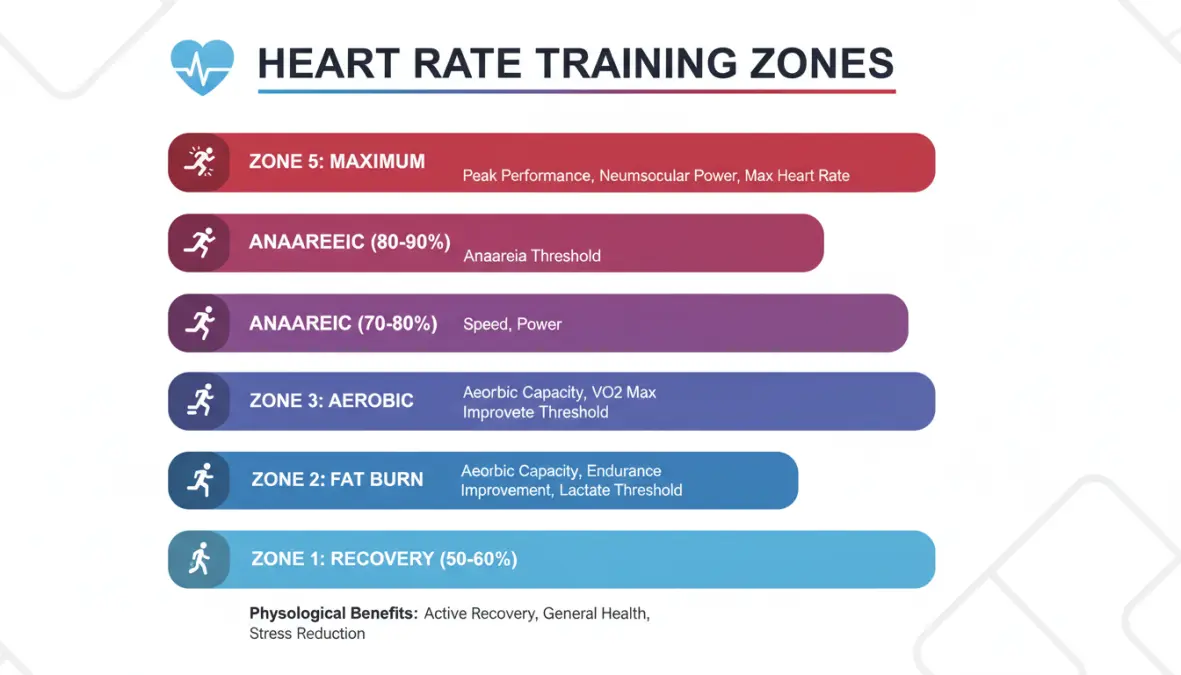
Here’s the standard 5-zone breakdown using percentage of max HR:
- Zone 1 (Recovery): 50-60% max HR – Active recovery, warm-up
- Zone 2 (Aerobic Base): 60-70% max HR – Easy endurance, fat burning
- Zone 3 (Tempo): 70-80% max HR – Moderate effort, aerobic development
- Zone 4 (Lactate Threshold): 80-90% max HR – Comfortably hard, race pace
- Zone 5 (VO2 Max): 90-100% max HR – Maximum effort, intervals
The lactate threshold heart rate typically falls at the upper end of Zone 3 or lower Zone 4—this is the critical inflection point where lactate accumulation accelerates. For endurance athletes, improving this threshold is key to better performance, which is why understanding lactate threshold testing can be invaluable.

Training in Each Heart Rate Zone: Benefits and Applications
Understanding what each zone does for your body—and how to distribute your training time—is where HR zones for running transforms from theory to results. Let’s dive into each zone with practical applications.
Zone 1 (Recovery): This feels embarrassingly easy—you can hold full conversations. Use it for active recovery between hard sessions, warm-ups, and cool-downs. Many athletes skip this entirely, which is fine, but it can enhance recovery blood flow when used strategically.
Zone 2 (Aerobic Foundation): This is your bread and butter. Zone 2 training heart rate builds mitochondrial density, enhances fat oxidation, and develops cardiovascular endurance without creating significant fatigue. You should be able to speak in full sentences, though not as comfortably as Zone 1. The best heart rate zone for fat burning falls here because your body preferentially uses fat as fuel at this intensity. For heart rate zones for marathon training, you’ll spend the majority of your weekly mileage in Zone 2.
The zone 2 heart rate training benefits are profound—this is where you build your aerobic engine. Research shows that elite endurance athletes spend 70-80% of their training time here. It feels too easy, but that’s the point. Pair this foundation work with proper hydration strategies and nutrition timing for optimal adaptation.
Zone 3 (Tempo): This feels moderately hard—you can speak in short phrases. Many recreational athletes inadvertently spend too much time here, which is neither easy enough for recovery nor hard enough for maximum adaptation. Use Zone 3 sparingly for tempo runs and as part of progressive long runs.
Zone 4 (Lactate Threshold): The difference between heart rate zones 3 and 4 is significant—Zone 4 is where you’re working at or near your lactate threshold, the pace you could theoretically hold for about an hour. This feels comfortably hard; speaking is difficult. Workouts here improve your body’s ability to clear lactate and sustain faster paces. Include threshold intervals of 10-20 minutes once or twice weekly during build phases.
Zone 5 (VO2 Max): Maximum effort where you can only gasp out single words. These short, intense intervals (typically 3-5 minutes) improve your aerobic capacity and maximum oxygen uptake. Use sparingly—once weekly at most—as they’re highly demanding. High-intensity interval training protocols often operate in this zone.
For practical application, beginners should focus almost exclusively on Zones 1-2 for the first 3-6 months. Intermediate athletes might follow an 80/10/10 split (80% Zone 1-2, 10% Zone 4, 10% Zone 5). Advanced athletes often use polarized training with 80% easy, 20% hard, minimizing time in Zone 3. Using a quality fitness tracker designed for multi-sport training makes monitoring these zones effortless during workouts.

FAQ
What is the best heart rate zone for fat burning?
Zone 2 (60-70% max HR) is optimal for fat oxidation because your body relies primarily on fat as fuel at this lower intensity. However, total calorie burn matters more for weight loss, so don’t neglect higher-intensity work entirely.
How long should I train in Zone 2?
For endurance athletes, aim for 70-80% of your total weekly training time in Zone 2. This might mean 3-5 hours weekly for serious runners or triathletes. Beginners can start with 30-45 minute sessions 3-4 times weekly.
Is it better to train by heart rate or pace?
Heart rate is generally more reliable because it accounts for variables like heat, fatigue, terrain, and recovery status that affect your body’s actual effort level. Pace can be misleading—your easy pace on a hot day might produce Zone 4 heart rate. That said, combining both metrics provides the most complete picture.
What’s the difference between aerobic and anaerobic zones?
Zones 1-3 are primarily aerobic, meaning your body uses oxygen to produce energy efficiently. Zones 4-5 increasingly recruit anaerobic pathways, producing lactate as a byproduct. The crossover happens around your lactate threshold in upper Zone 3/lower Zone 4.
Do heart rate zones change with fitness level?
Your maximum heart rate remains relatively stable (decreasing slightly with age), but your zones’ functional meaning shifts. As fitness improves, you’ll run faster at the same heart rate, and your lactate threshold heart rate increases. Recalculate zones every 8-12 weeks during serious training blocks.
Mastering heart rate zones training isn’t complicated, but it requires patience and discipline—especially the discipline to keep your easy days truly easy. Combined with solid mental training practices and proper mobility work, training in the right zones will unlock performance gains you didn’t think possible. Whether you’re preparing for your first triathlon or chasing a personal best, your heart rate monitor might just be the most valuable training tool you own. Start paying attention to those numbers, trust the process, and watch your endurance soar.