Running Gait Analysis: How to Correct Your Form and Prevent Injuries
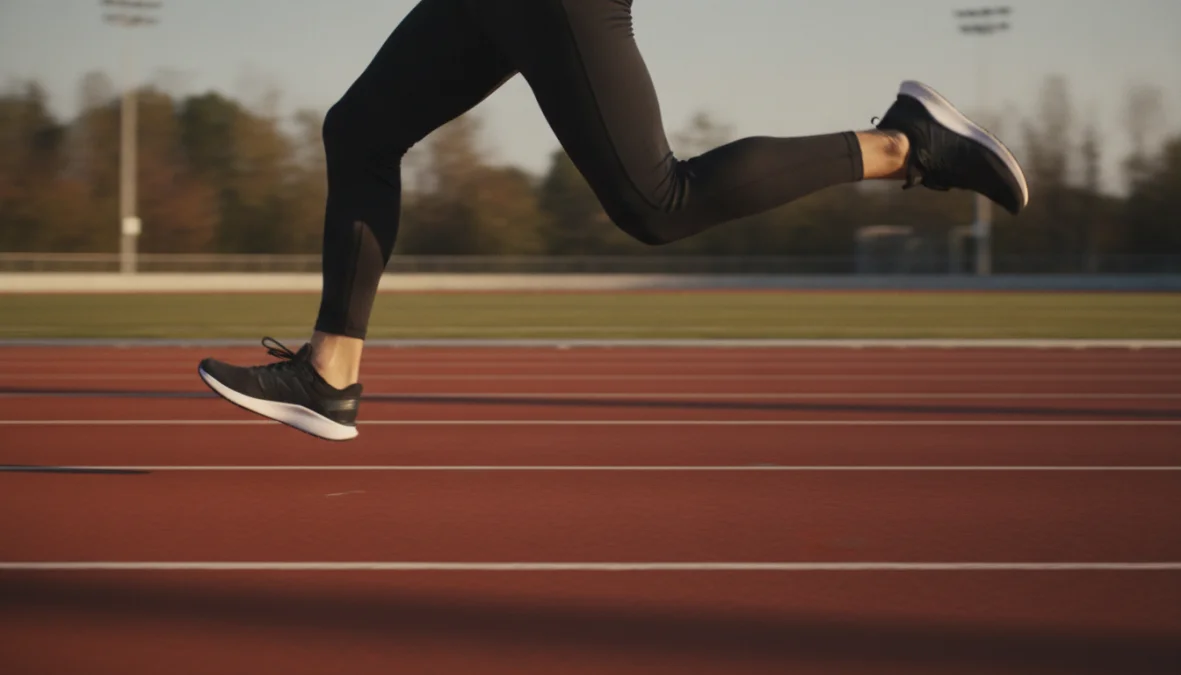
Ever wondered why some runners glide effortlessly while others seem to pound the pavement with every step? The secret often lies in their gait. Whether you’re training for your first 5K or chasing a new marathon PR, understanding your running gait analysis can be the game-changer that keeps you injury-free and running stronger. Let’s dive into how analyzing and correcting your running form can transform your performance and help you stay on the road longer.
What Is Running Gait Analysis and Why It Matters
Running gait analysis is essentially a detailed examination of how your body moves while running. It breaks down your running cycle into two main phases: the stance phase (when your foot is on the ground) and the swing phase (when your foot is in the air). During the stance phase, which accounts for about 40% of your gait cycle, your foot absorbs impact and propels you forward. The swing phase makes up the remaining 60%, as your leg recovers and prepares for the next footfall.
Why should you care about all this technical stuff? Because proper gait analysis helps you prevent injuries before they derail your training. It identifies compensations you might not even know you’re making—like favoring one leg or overstriding—that put unnecessary stress on your joints. By understanding these mechanics, you can improve your running efficiency, meaning you’ll use less energy to maintain the same pace. This matters whether you’re a weekend jogger or a competitive athlete. Think of it as a diagnostic tool that reveals the hidden weaknesses in your running form, giving you a roadmap to become a better, healthier runner.
Key Elements of Proper Running Form
Getting your running form dialed in requires attention to several interconnected elements. Let’s break down the most critical components that a comprehensive gait analysis will evaluate.
Foot Strike Patterns and Cadence
Your foot strike—how your foot contacts the ground—comes in three main varieties: heel strike (landing on your heel first), midfoot strike (landing on the middle of your foot), and forefoot strike (landing on the ball of your foot). Here’s the truth: there’s no universally “best” strike pattern. Elite runners use all three types successfully. However, aggressive heel striking, where your foot lands well ahead of your body’s center of mass, can increase braking forces and injury risk.
Equally important is your cadence—the number of steps you take per minute. Most running experts recommend aiming for 170-180 steps per minute. A lower cadence often means you’re overstriding, which increases impact forces on your joints and can lead to knee pain and other injuries. To check your cadence, count how many times one foot hits the ground in 30 seconds, multiply by four, then double it.
Posture, Arm Swing, and Hip Alignment
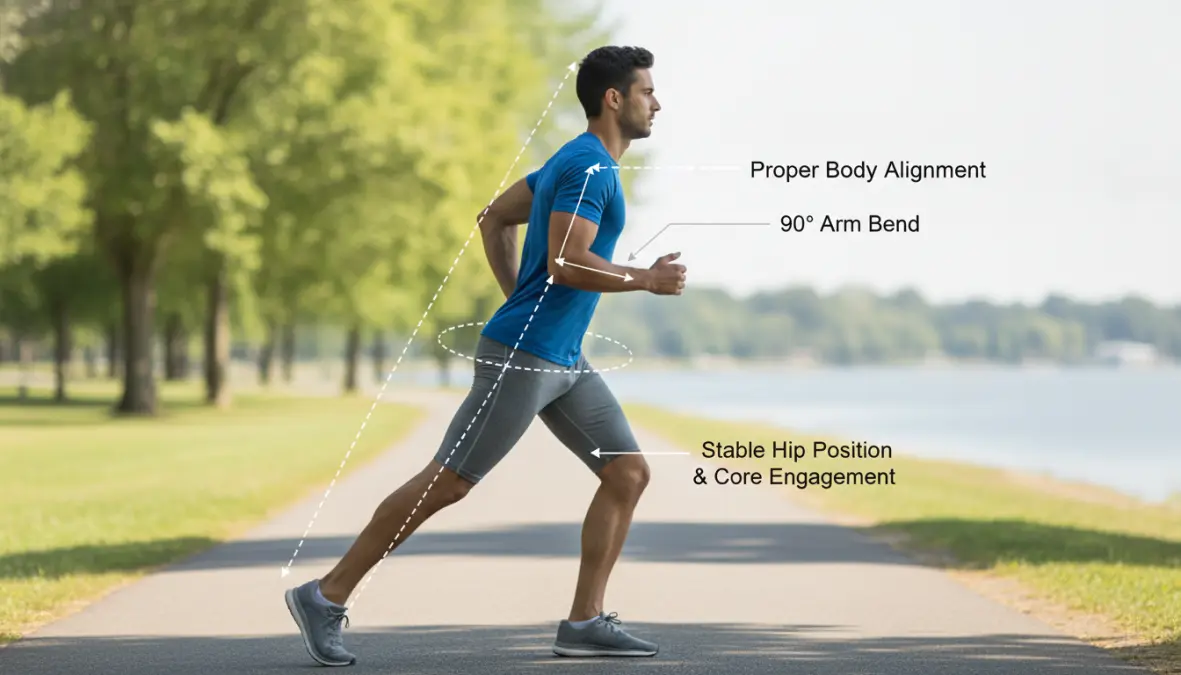
Correct form starts with posture. You want a slight forward lean from your center of mass (not from your waist), which helps you use gravity to propel yourself forward. Imagine a string pulling you gently from the top of your head. Your shoulders should be relaxed and level, not hunched or rotating excessively.
Your arms play a bigger role than you might think. Keep your elbows bent at roughly 90 degrees, swinging forward and back (not across your body). Excessive torso rotation wastes energy and can throw off your hip alignment. Speaking of hips, they should stay level and stable. Hip drop—when one hip dips significantly when the opposite foot strikes the ground—is a common issue that often stems from weak gluteal muscles. Strong core engagement ties everything together, providing the stability platform from which your legs can move efficiently. Consider incorporating mobility training to improve your overall movement quality.
Common Gait Problems and How to Fix Them
A thorough running gait analysis typically reveals one or more common biomechanical issues. Let’s identify the most frequent culprits and, more importantly, how to fix them to prevent injuries.
Overpronation occurs when your foot rolls inward excessively after landing. This can stress your ankles, knees, and hips, potentially causing shin splints, plantar fasciitis, and IT band syndrome. If you notice excessive wear on the inside edge of your running shoes, overpronation might be your issue. Corrective exercises include single-leg balance drills, calf raises, and strengthening your posterior tibialis muscle. For severe cases, motion control shoes or custom orthotics can help.
Supination (or underpronation) is the opposite problem—your foot doesn’t roll inward enough, leaving you with poor shock absorption. This typically leads to stress fractures and ankle injuries. Runners with high arches often supinate. Focus on ankle mobility work and choose neutral, cushioned shoes with good flexibility.
Crossover gait happens when your feet land too close to or across your body’s midline, creating a narrow running base. This destabilizes your pelvis and can cause hip and knee pain. Hip strengthening exercises, particularly targeting your glute medius with side-lying leg raises and clamshells, can correct this pattern. Running drills like high knees with a focus on landing each foot under its respective hip also help.
Aggressive heel striking combined with overstriding creates a braking effect with each step, increasing impact forces dramatically. You’ll recognize this if you hear loud footfalls or experience frequent shin splints and knee pain. The fix involves increasing your cadence to 170-180 steps per minute, which naturally shortens your stride. Practice running in place, then lean forward slightly to start moving—this teaches proper foot placement under your center of mass.
Hip drop reveals weak hip stabilizers, particularly your gluteus medius. This compensation pattern overloads your IT band and can cause lateral knee pain. Single-leg exercises are your friend here: single-leg deadlifts, pistol squats (or assisted versions), and lateral band walks all strengthen the muscles that keep your hips level. While strengthening work is crucial, remember that shoes alone can’t fix these issues—they’re just one tool in your correction toolkit.
FAQ: Running Gait Analysis
How can I analyze my running gait at home?
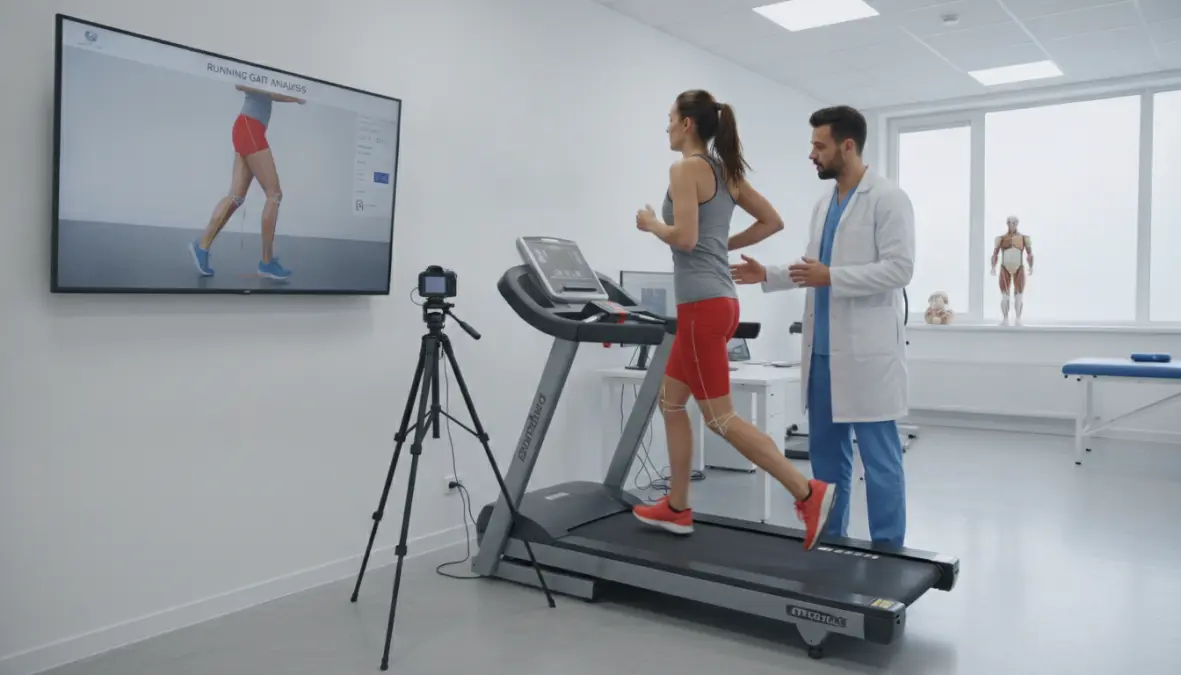
You don’t need fancy equipment to get started. Record yourself running on a treadmill from the side and behind using your smartphone’s slow-motion feature. If possible, position your phone near a mirror so you can get multiple angles. Watch for the key issues we’ve discussed: where your foot lands relative to your body, how much your hips drop, and your overall posture. Compare what you see to videos of proper running form online. For a more comprehensive assessment similar to sports performance testing, many running stores offer complimentary gait analysis sessions.
Do I need a professional gait analysis?
If you’re experiencing recurring injuries despite rest and recovery, a professional analysis is definitely worth it. Similarly, if you’ve hit a performance plateau and can’t figure out why, a gait specialist might identify inefficiencies holding you back. Professional analysis uses high-speed cameras, force plates, and expert interpretation to catch subtle issues you’d miss on your own. Most sports medicine clinics and specialized running stores offer this service, with costs ranging from free (basic retail analysis) to several hundred dollars (comprehensive biomechanical assessment).
How long does it take to correct running form?
Patience is key here. Your body has been running a certain way for years, so expect meaningful changes to take 4-8 weeks of consistent, mindful practice. Start by incorporating form drills and corrective exercises 2-3 times per week. When working on gait changes during runs, begin with short segments—maybe 5 minutes at a time—rather than trying to maintain perfect form for an entire run. Your body needs time to build the strength and neuromuscular patterns to support better mechanics. Rushing the process increases injury risk.
Can running shoes fix gait issues?
Shoes are helpful but not magical. Motion control shoes can provide some support for overpronation, and cushioned neutral shoes can help supinators, but they won’t address the underlying muscle weaknesses or movement patterns causing the problem. Think of shoes as a temporary aid while you strengthen and retrain your body. The real fixes come from targeted exercises, improved mobility, and gradual gait retraining. No shoe can replace strong glutes, stable hips, and proper running mechanics. Proper position and form matter just as much in running as they do in cycling.
Understanding your running gait isn’t just for elite athletes—it’s a fundamental tool for any runner who wants to stay healthy and perform their best. By identifying your unique movement patterns and making targeted corrections, you’re investing in years of enjoyable, injury-free running. Start with a simple video analysis at home, focus on one or two key improvements, and be patient with the process. Your knees, hips, and future race times will thank you.