Cycling Gear Ratios Explained: How to Choose the Right Cassette for Your Ride
Ever feel like you’re pedaling through peanut butter on a climb, or spinning out like a hamster on a wheel during a descent? Chances are, your cycling gear ratios aren’t quite right for the terrain you’re tackling. Understanding how gear ratios work—and more importantly, how to choose the right cassette for your riding style—can transform your experience on the bike. Whether you’re grinding up steep hills or cruising on flat roads, getting your bike gear ratios dialed in means riding smarter, not harder.
What Are Cycling Gear Ratios and Why Do They Matter?
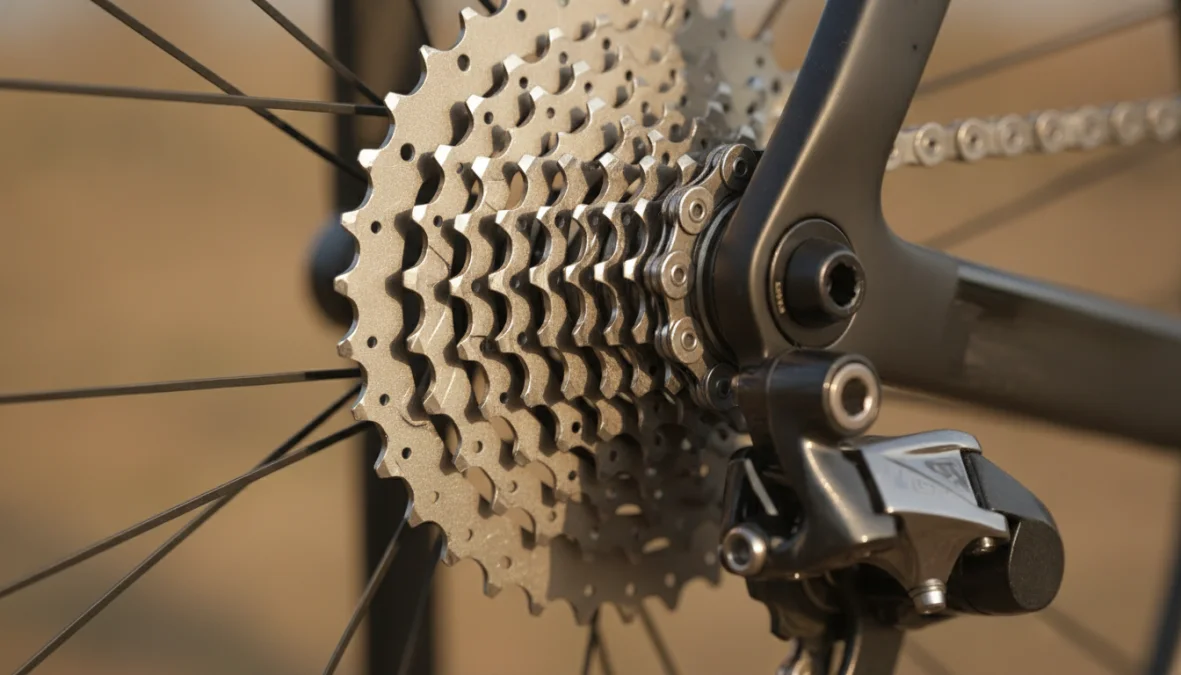
At its core, a cycling gear ratio is simply the relationship between your chainring size (the big ring up front attached to your cranks) and the sprocket teeth on your cassette (the cluster of cogs on your rear wheel). When you divide the number of teeth on your chainring by the number of teeth on a given cog, you get your gear ratio. For example, if you’re running a 50-tooth chainring and shift into an 11-tooth cog, your ratio is 50/11 = 4.5. In contrast, a 34-tooth chainring paired with a 32-tooth cog gives you 34/32 = 1.06—a much lower ratio.
So what do these numbers actually mean? Higher drivetrain ratios (like 4.5) mean you travel further with each pedal stroke, perfect for maintaining speed on flat terrain or descents. Lower ratios (like 1.06) make each pedal stroke easier but cover less ground—ideal for climbing gears when you’re facing steep gradients. This directly impacts your cadence (how fast you’re spinning your pedals) and whether you’re spinning vs grinding. Most cyclists perform best with a cadence between 80-100 rpm, which you can optimize through proper cadence training.
Beyond the basic ratio, some cyclists also reference a gear inch calculator, which measures how far your bike travels with one pedal revolution based on wheel size—a throwback measurement from penny-farthing days. While less common today, it provides another lens for understanding your bicycle gearing setup, especially useful when comparing bikes with different wheel sizes.
How to Calculate and Choose the Right Gear Ratios
Now that you understand what gear ratios are, let’s dig into the practical side: calculating them and choosing the right setup for your riding.
Understanding the Math Behind Gear Ratios
The formula couldn’t be simpler: Chainring teeth ÷ Cassette cog teeth = Gear ratio. Let’s work through some real examples. With a compact 50/34 crankset (50 teeth on the big ring, 34 on the small) and an 11-28 cassette, your highest gear would be 50/11 = 4.5, and your lowest would be 34/28 = 1.2. Compare that to an 11-32 cassette with the same crankset: your highest stays at 4.5, but your lowest drops to 34/32 = 1.06—a bailout gear that’s about 13% easier.
Doing these calculations for every cog can be tedious, which is where a gear ratio calculator becomes invaluable. Online tools let you input your chainring ratios and cassette ratios, instantly showing you all your available gears, overlap between chainring combinations, and even speed at specific cadences. This takes the guesswork out of understanding how to calculate cycling gear ratios across your entire drivetrain.
Matching Cassette Ratios to Your Riding Style
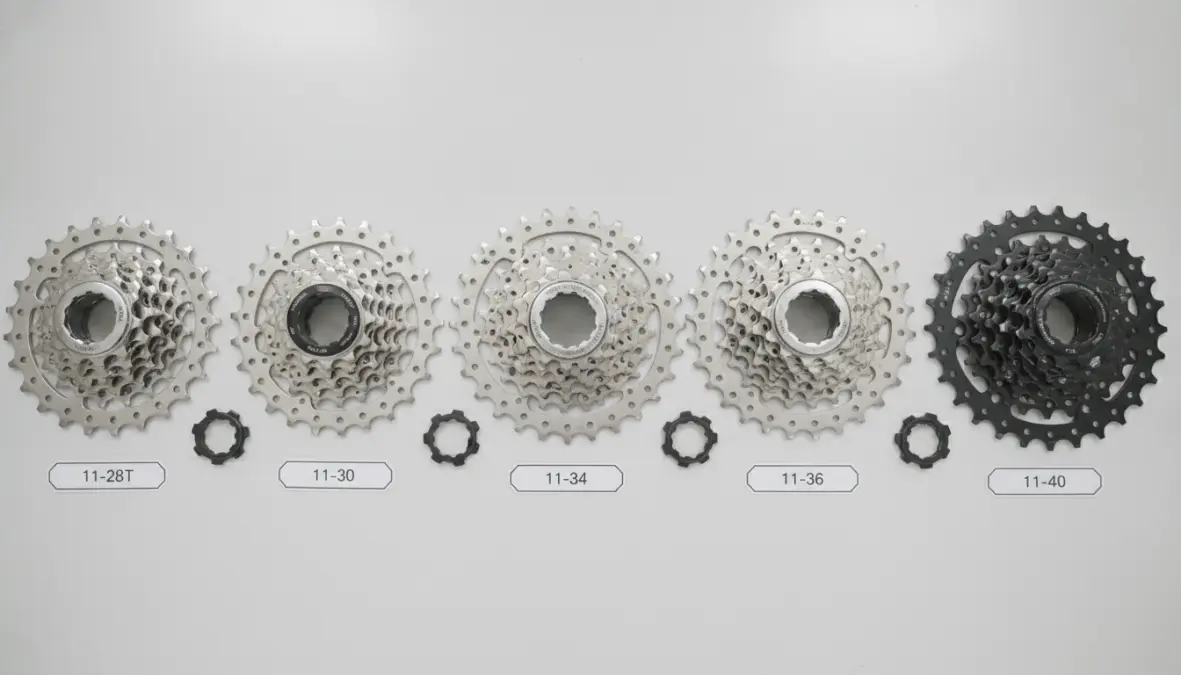
Choosing the right cassette depends entirely on where and how you ride. Here’s a practical breakdown of common cog selection options:
- 11-28 cassette: The choice for flat to rolling terrain and road racing. Offers tight jumps between gears for maintaining optimal cadence, but limited bailout options for steep climbs. Pairs well with standard (53/39) or compact (50/34) cranksets. These represent the best gear ratios for road cycling on moderate terrain.
- 11-32 cassette: A versatile all-rounder that’s become increasingly popular. The difference between 11-28 and 11-32 cassette is that extra 32-tooth cog, providing significantly easier climbing without sacrificing top-end speed. Great for sportive riders and hilly routes.
- 11-34 cassette: For serious climbing or if you’re wondering how to choose the right cassette for climbing, this is your answer. That 34-tooth cog paired with a 34-tooth inner chainring gives you a 1:1 ratio—about as easy as it gets with traditional drivetrains. Perfect for mountainous terrain or loaded touring.
- 10-50 or 10-51 cassette (1x systems): Modern wide-range cassettes designed for single-chainring setups. Common in gravel and mountain biking, they offer massive range but larger jumps between gears. When choosing cassette for gravel bike adventures, these provide the versatility for everything from pavement to technical climbs.
Don’t forget to consider your derailleur capacity—the maximum tooth difference your rear derailleur can handle. A short-cage derailleur typically maxes out around 11-28, while medium and long-cage versions accommodate larger cassettes. Mixing components without checking capacity is a recipe for poor shifting or a broken derailleur.
Common Gear Ratio Questions Answered
What gear ratio is best for climbing?
For gear ratios for steep hills cycling, you want the lowest ratio possible while maintaining a comfortable cadence. A 1:1 ratio (like 34/34) or lower (34/32 = 1.06) works brilliantly for most riders on gradients above 10%. Lighter riders or those with strong legs might manage with slightly higher ratios like 34/28 (1.2), while heavier riders or those tackling extremely steep pitches benefit from even lower ratios available with wide-range cassettes.
How do I know if my gear ratios are too hard or easy?
If you’re constantly grinding at cadences below 70 rpm on climbs, your ratios are too hard—you’re sacrificing efficiency and risking knee strain. Conversely, if you’re spinning out (exceeding 110+ rpm) on descents or flats when trying to go fast, you need higher gears. The sweet spot is maintaining 80-100 rpm across most terrain, which requires proper nutrition—check out strategies for fueling your rides.
Can I change my cassette without changing my chainring?
Absolutely! This is one of the easiest drivetrain upgrades. Just ensure your derailleur has sufficient capacity for the new cassette range, and you may need to adjust your B-screw and cable tension. Going from an 11-28 to an 11-32, for instance, requires a medium-cage derailleur but keeps your existing chainrings. It’s a cost-effective way to adapt your gearing for different terrain.
What’s the difference between gear inches and gear ratios?
Gear ratios are dimensionless numbers showing mechanical advantage, while gear inches measure the effective wheel diameter, accounting for your actual wheel size. A gear inch calculator gives you the distance traveled per pedal revolution—useful for comparing setups across different wheel sizes (700c vs 650b, for example). Most modern cyclists stick with gear ratios for simplicity, but gear inches provide more absolute measurements.
Should I choose a wide-range or close-range cassette?
It depends on your priorities. Close-range cassettes (11-25, 11-28) offer smaller jumps between gears, letting you fine-tune your cadence—ideal for racing, time trials, or flat terrain. Wide-range cassettes (11-34, 10-50) sacrifice some smoothness for versatility, giving you bail-out gears for unexpected climbs or varied terrain. For most recreational riders tackling diverse routes, a mid-range option like 11-32 strikes the best balance.
Finding Your Perfect Setup
Understanding cycling gear ratios empowers you to customize your bike for the riding you actually do, not just what came stock. Whether you’re preparing for multi-day bikepacking adventures requiring low gears for loaded climbing, or optimizing your aerodynamics and gearing for racing, the right cassette makes all the difference. Start by honestly assessing your typical routes and fitness level, run the numbers through a gear ratio calculator, and don’t be afraid to experiment. That perfect combination of chainring size and cassette range is out there—and once you find it, every ride becomes that much more enjoyable. Now get out there and put those ratios to work!