Watts Per Kg Cycling: Complete Guide to Power-to-Weight Ratio Performance

Ever wondered why some riders fly up climbs while others struggle, even though they’re pushing similar wattage? The answer lies in watts per kg cycling, arguably the most important performance metric for any cyclist who wants to understand their true capabilities. Unlike raw power output, your power-to-weight ratio tells the real story of how efficiently you’re moving your body mass against gravity—and it’s the secret weapon that separates category racers from weekend warriors.
What Is Watts Per Kilogram in Cycling?
Watts per kg cycling is your power to weight ratio cycling metric—simply put, it’s how much power you produce divided by your body weight. The formula is straightforward: take your cycling power output (measured in watts) and divide it by your weight in kilograms. So if you’re pushing 250 watts and weigh 70 kg, your w/kg is 3.57.
Why does this matter more than absolute watts? Let’s say Rider A weighs 60 kg and produces 240 watts (4.0 w/kg), while Rider B weighs 80 kg and cranks out 280 watts (3.5 w/kg). On flat terrain or in a sprint, Rider B’s higher absolute power might give them an edge. But the moment the road tilts upward, Rider A will pull away—because climbing is fundamentally about moving mass against gravity, and they’re carrying less weight per watt produced.
Most cyclists use their functional threshold power (FTP) as the baseline for calculating w/kg. FTP represents the maximum power you can sustain for roughly an hour, making it the gold standard for measuring sustainable cycling performance. Using a bike power meter is essential for accurate measurement, as it captures real-time power data that forms the foundation of all your cycling performance metrics.
FTP Watts Per Kg: Benchmarks and Performance Categories
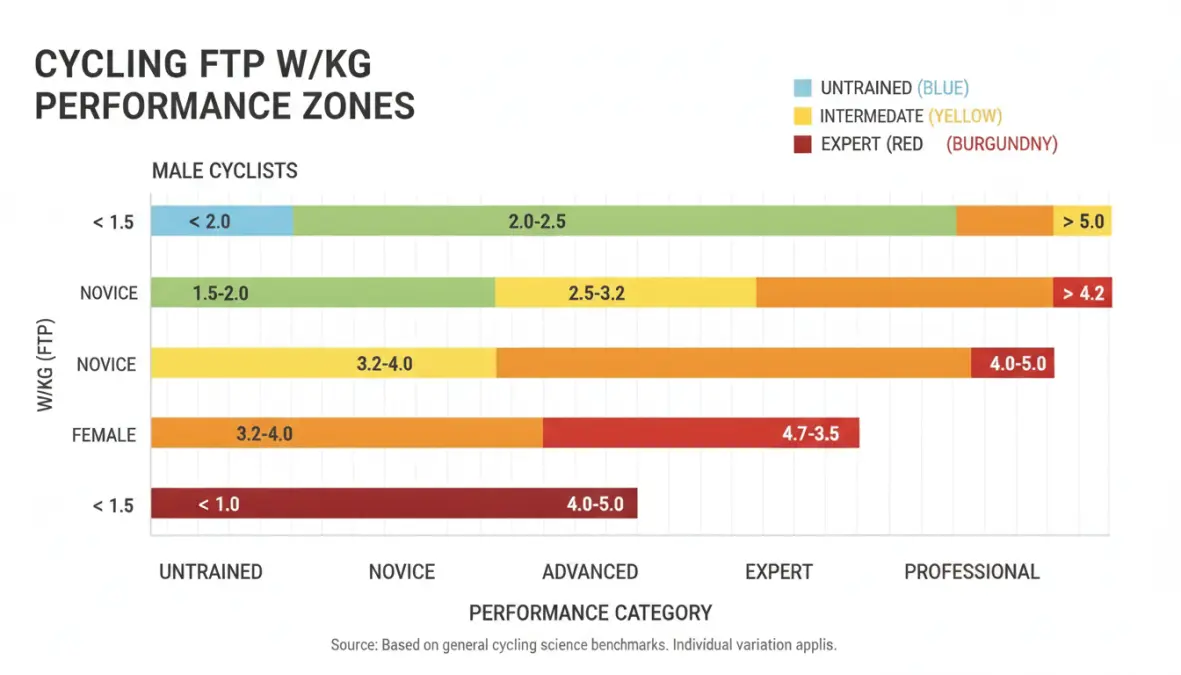
Understanding where you stand on the w/kg cycling chart helps set realistic goals and measure progress. Here’s how ftp watts per kg typically breaks down across performance levels:
- Untrained: Men 2.0-2.5 w/kg, Women 1.5-2.0 w/kg
- Recreational: Men 2.5-3.0 w/kg, Women 2.0-2.5 w/kg
- Trained: Men 3.0-4.0 w/kg, Women 2.5-3.5 w/kg
- Well-Trained (Cat 3-2): Men 4.0-5.0 w/kg, Women 3.5-4.5 w/kg
- Elite/Professional: Men 5.0-6.5+ w/kg, Women 4.5-6.0+ w/kg
Notice the gender differences? Women typically have 0.5-1.0 w/kg lower benchmarks, largely due to physiological differences in muscle mass distribution and body composition. This doesn’t reflect lesser fitness—it’s why comparing cycling performance metrics should always account for these variables. As highlighted in women’s professional cycling, elite female athletes demonstrate extraordinary power-to-weight capabilities within their category.
Your functional threshold power w/kg number directly translates to real-world performance. A recreational rider at 2.8 w/kg will comfortably finish gran fondos but struggle in competitive races. Hit 4.0 w/kg, and you’re competitive in Cat 3 racing. Professional climbers like those competing in grand tours often exceed 6.0 w/kg during sustained efforts—numbers that seem superhuman to most riders.
How to Calculate Your Watts Per Kilogram
Calculating your watts per kilogram requires two accurate measurements. First, determine your FTP through a proper threshold power testing protocol—either a 20-minute all-out test (multiply result by 0.95) or a ramp test to exhaustion. Most cycling apps and smart trainers include automated FTP tests that make this process straightforward.
Second, weigh yourself correctly: first thing in the morning, after using the bathroom, wearing minimal clothing. Consistency matters—your weight fluctuates throughout the day due to hydration and food intake.
Once you have both numbers, the formula is simple: FTP (watts) ÷ Body Weight (kg) = w/kg. Many online watts per kilogram calculators and training platforms like TrainingPeaks, Zwift, or Strava automatically calculate this metric if you keep your weight updated. Re-test your FTP every 6-8 weeks during focused training blocks, or when you notice significant performance changes.
Why Power-to-Weight Ratio Matters More Than Absolute Power
Physics doesn’t lie: on climbs, you’re fighting gravity, and gravity doesn’t care about your absolute wattage—only how much mass you’re hauling upward. A 300-watt effort from an 85 kg rider (3.5 w/kg) will be slower up a mountain than 270 watts from a 60 kg climber (4.5 w/kg). This is why pure climbers often weigh significantly less than sprinters or time trialists.
That said, absolute power still matters in specific scenarios. On flat roads, aerodynamic drag becomes the dominant force, where higher absolute watts help overcome wind resistance regardless of weight. In sprints, pure power output determines acceleration. In time trials, a combination of absolute power and aerodynamics (as discussed in our aerodynamics guide) creates speed.
Smart race strategy considers both metrics. A lighter climber might attack on steep gradients where their power to weight ratio cycling advantage shines, while a powerful rouleur saves energy for flat sections or attacks on shallow climbs where absolute watts matter more.
How to Improve Your Watts Per Kg for Better Cycling Performance
Improving your cycling power output relative to body weight involves a two-pronged approach: increasing your FTP or decreasing your weight—ideally both, but with careful balance. Losing weight at the expense of power is counterproductive.
On the training side, focus on structured interval work that builds functional threshold power and VO2 max cycling capacity. Sweet spot intervals (88-94% FTP) done 2-3 times weekly improve sustainable power. VO2 max sessions—short, intense efforts at 120% FTP—push your ceiling higher. As covered in our spring training guide, building a solid aerobic base before intensity work maximizes gains.
Don’t neglect cadence and power output optimization—finding your efficient pedaling rate helps maintain higher watts with less fatigue. Proper periodization prevents burnout: build fitness during base phases, sharpen with intensity pre-event, then recover adequately.
For weight management, avoid crash diets that sacrifice muscle and power. Instead, follow sensible nutrition timing—strategic carbohydrate intake fuels hard training while allowing gradual, sustainable weight loss if needed. Aim for no more than 0.5 kg loss weekly to preserve muscle mass.
Track progress through regular cycling performance analysis: retest FTP monthly, log weight consistently, and watch your w/kg trend upward. Realistic improvements? New cyclists might gain 0.5-1.0 w/kg in their first year. Experienced riders should expect 0.2-0.3 w/kg annual gains, with diminishing returns as you approach your genetic ceiling. Whether you’re preparing for events like century rides or local crits, consistent training beats crash programs every time.
FAQ
What is a good watts per kg for cycling?
For recreational riders, 2.5-3.5 w/kg represents solid fitness. Competitive amateur racers typically achieve 3.5-4.5 w/kg, while elite riders exceed 5.0 w/kg. Context matters—a “good” number depends on your goals, whether that’s completing sportives comfortably or winning category races in your local scene.
How do I calculate my cycling watts per kilogram?
Divide your FTP (functional threshold power in watts) by your body weight in kilograms. For example: 280 watts FTP ÷ 70 kg body weight = 4.0 w/kg. Test your FTP using a 20-minute maximum effort (multiply by 0.95) or a ramp test, and weigh yourself consistently under the same conditions.
What is the average FTP watts per kg?
Most recreational cyclists fall between 2.5-3.5 w/kg, with 3.0 w/kg being a common midpoint. This level supports comfortable group rides and completing gran fondos. Regular structured training can push motivated riders toward 3.5-4.0 w/kg, where competitive racing becomes viable.
Can you improve watts per kg without losing weight?
Absolutely. Focused training that builds FTP through interval work, threshold sessions, and VO2 max efforts increases your power output while maintaining body weight. This approach works particularly well for lighter riders or those already at healthy weight who simply need to build more strength and aerobic capacity.
What watts per kg do pro cyclists have?
Professional climbers typically sustain 5.5-6.5+ w/kg during mountain stages, with some grand tour winners exceeding 6.8 w/kg on decisive climbs. Time trial specialists might be lower (4.5-5.5 w/kg) due to greater muscle mass, while all-rounders sit around 5.5-6.0 w/kg. These numbers represent years of elite-level training and genetic gifts.
Understanding your watts per kg cycling performance opens the door to smarter training, realistic goal-setting, and genuine improvement. Whether you’re chasing podiums or personal bests, this metric cuts through the noise and reveals your true cycling potential. Start measuring, train consistently, and watch those numbers climb.