Neuromuscular Power Intervals: Training Explosive Force for Cyclists
Ever wonder why some cyclists can unleash devastating sprint power while others struggle to make a dent in the pack? The secret isn’t just about training harder—it’s about training smarter with neuromuscular power cycling workouts. These explosive intervals aren’t your typical grinding threshold sessions or lung-busting VO2max efforts. Instead, they target the connection between your brain and muscles, teaching your body to recruit muscle fibers faster and produce force like a lightning bolt. Whether you’re chasing criterium wins or just want to nail that sprint finish in your next group ride, neuromuscular power intervals deserve a spot in your training plan.
What Is Neuromuscular Power Training in Cycling?
Neuromuscular training cycling focuses on developing your body’s ability to generate maximum force in minimal time. Unlike sustained efforts that stress your cardiovascular system, these short, explosive bursts train the neural pathways that control force production cycling. Think of it as upgrading the software that runs your muscular hardware.
The magic happens in your nervous system. When you perform an all-out sprint, your brain must rapidly activate motor units—groups of muscle fibers controlled by a single nerve. Neuromuscular power cycling improves this motor unit activation, particularly targeting type II muscle fibers (your fast-twitch powerhouses) that remain dormant during steady-state riding. This recruitment efficiency determines your peak power output and rate of force development—how quickly you can go from cruising to crushing.
So when should you include this training? If you compete in crits, road races with sprint finishes, or mountain bike events requiring repeated explosive efforts, neuromuscular intervals are essential. They’re also valuable during early-season preparation to build a foundation of force production before transitioning to more sustained spring training efforts. Unlike VO2max or threshold work that builds aerobic capacity, neuromuscular sessions teach your body to fire on all cylinders instantly.
How to Execute Neuromuscular Power Intervals Correctly
Getting power intervals cycling right requires precision. These aren’t “pretty hard” efforts—they’re maximal, all-out explosions that demand full recovery between reps. The protocol is straightforward but unforgiving: 10-20 second sprints at absolute maximal power output cycling, followed by 3-5 minutes of easy spinning or complete rest.
Here’s what proper execution looks like: After a thorough 15-20 minute warm-up (critical for injury prevention), you’ll unleash everything you’ve got for those brief intervals. Your explosive power cycling efforts should feel like you’re trying to rip the pedals off your bike. Intensity matters more than duration—quality always trumps quantity in sprint power training cycling.
Frequency should be conservative: 1-2 sessions per week maximum. These workouts tax your neuromuscular system heavily, and recovery is where adaptation happens. Start with 4-6 repetitions and progress to 8-10 as your body adapts over several weeks. A power meter helps track your output, ensuring you’re truly going maximal on each rep.
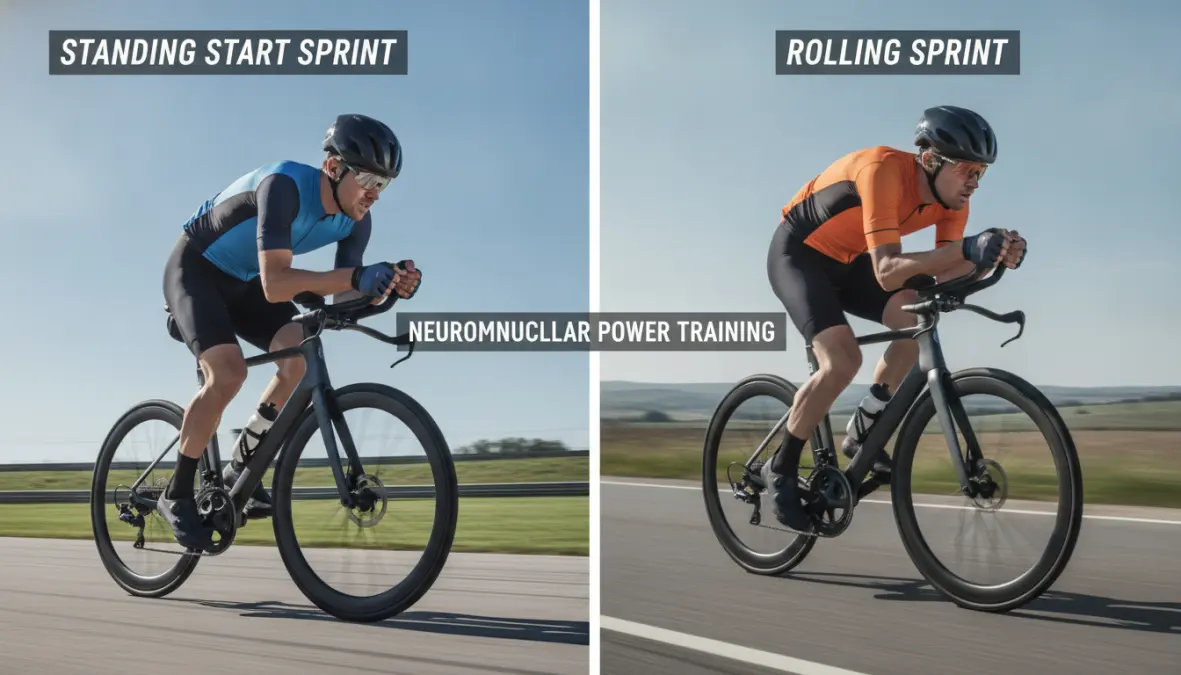
Three effective variations exist for neuromuscular power interval training protocol: Standing starts from near-zero speed (pure force development), rolling sprints starting from 15-20 kph (mimics race scenarios), and big gear efforts at low cadence (50-60 rpm) focusing on raw strength. Mix these throughout your training block to develop well-rounded explosive capabilities.
Common mistakes to avoid: insufficient warm-up (increases injury risk), inadequate recovery between intervals (turns it into an anaerobic session), and trying to do these when fatigued from previous training. These sessions work best when you’re fresh, ideally 48+ hours after hard workouts. Combine them with strength training and plyometric work for optimal neuromuscular development.
Sample Neuromuscular Workout Protocol
Beginner Protocol: 15-minute warm-up, then 5 x 10-second all-out standing starts from trackstand, 4-minute easy recovery between efforts, 10-minute cool-down.
Intermediate Protocol: 20-minute warm-up with progressive efforts, 6 x 15-second rolling sprints (start at 18 kph), 5-minute recovery, 10-minute cool-down.
Advanced Protocol: 20-minute warm-up, 8 x 20-second mixed efforts (alternating standing starts, rolling sprints, and big gear grinds), 5-minute recovery, include cadence variation training during recovery periods, 15-minute cool-down.
Benefits and Physiological Adaptations
The neuromuscular adaptations cycling training produces are distinctly different from aerobic improvements. While endurance work increases mitochondrial density and capillary networks, neuromuscular intervals enhance the speed and efficiency of nerve signal transmission. Your brain literally learns to recruit more muscle fibers simultaneously and fire them faster—improving both maximal power output cycling and coordination.
Specifically, you’ll develop improved muscle fiber recruitment patterns, particularly among your high-threshold motor units controlling type II fibers. These adaptations increase your rate of force development—the slope of your power curve when you jump. This means reaching peak watts faster, crucial for closing gaps, following attacks, or launching your own offensive moves.
Synchronization matters too. Neuromuscular training improves intermuscular coordination, teaching your quads, glutes, hamstrings, and calves to fire in perfect harmony. This coordinated contraction pattern generates more total force than individual muscles working independently. You’ll also see improvements in power-to-weight ratio without necessarily adding muscle mass, as neural efficiency gains come first.
Practical applications span all cycling disciplines. Road racers need explosive force production cycling for sprint finishes and bridging gaps. Criterium specialists rely on repeated accelerations out of every corner. Mountain bikers use neuromuscular power for technical climbs and punchy attacks. Even time trialists benefit from the improved starting acceleration and ability to surge over short rises without losing momentum.
Understanding neuromuscular power vs aerobic intervals cycling helps optimize training: aerobic work builds the engine’s capacity, while neuromuscular training sharpens its responsiveness. One develops anaerobic capacity through sustained efforts; the other maximizes instantaneous power through neural adaptations. Both matter, but they’re trained differently and serve distinct purposes in race situations.
FAQ: Neuromuscular Power Training for Cyclists
How often should cyclists do neuromuscular intervals?
Most cyclists benefit from 1-2 neuromuscular sessions weekly, spaced 2-3 days apart. More frequent training doesn’t allow adequate neural recovery and risks diminishing returns. During peak racing blocks, one maintenance session weekly preserves adaptations while prioritizing race-specific intensity.
Can beginners do neuromuscular power training?
Yes, but start conservatively. New cyclists should first establish a base fitness foundation and proper bike position, then begin with 4-5 shorter intervals (10 seconds) using rolling starts. Standing starts and big gear efforts require more experience and core stability to execute safely.
What’s the difference between neuromuscular and VO2max intervals?
Neuromuscular intervals are maximal 10-20 second efforts training neural recruitment and explosive force. VO2max intervals last 3-8 minutes at 105-120% FTP, targeting cardiovascular capacity and oxygen utilization. Different energy systems, different adaptations, both valuable for complete development.
Do neuromuscular intervals build muscle mass?
Not significantly. These brief efforts primarily trigger neural adaptations rather than hypertrophy. Initial strength gains come from improved recruitment efficiency, not muscle growth. For muscle development, combine neuromuscular work with dedicated gym-based strength training using heavier resistance and higher volume.
When in the training season should I focus on neuromuscular power?
Incorporate neuromuscular work during base phase (lower volume) and build phase (moderate volume). Maintain with weekly sessions during race season. Reduce frequency during recovery weeks. Early season emphasis on explosive force development for cycling performance creates a foundation for later race-specific intensity.
Neuromuscular power intervals might be the missing ingredient in your training recipe. They’re not about suffering through long, grinding efforts—they’re about teaching your body to produce explosive force efficiently. When that decisive race moment arrives and you need to respond to an attack or launch your sprint, your neuromuscular training will make the difference between watching the race ride away and staying in the fight. Start conservative, prioritize quality over quantity, and watch your explosive capabilities transform over time.