
Collagen Supplements for Joint Health: Evidence-Based Guide for Cyclists and Runners

If you’re a runner or cyclist logging serious miles each week, you’ve probably felt that familiar ache in your knees, the stiffness in your ankles after a long ride, or that nagging discomfort that makes you wonder how long your joints can keep up with your training. As collagen supplements athletes are increasingly turning to for joint support, the question isn’t whether joint health matters—it’s whether these supplements actually deliver on their promises. Let’s dig into what the science says and how endurance athletes can strategically use collagen to protect their most vulnerable tissues.
Why Collagen Matters for Endurance Athletes: Joint Health and Performance
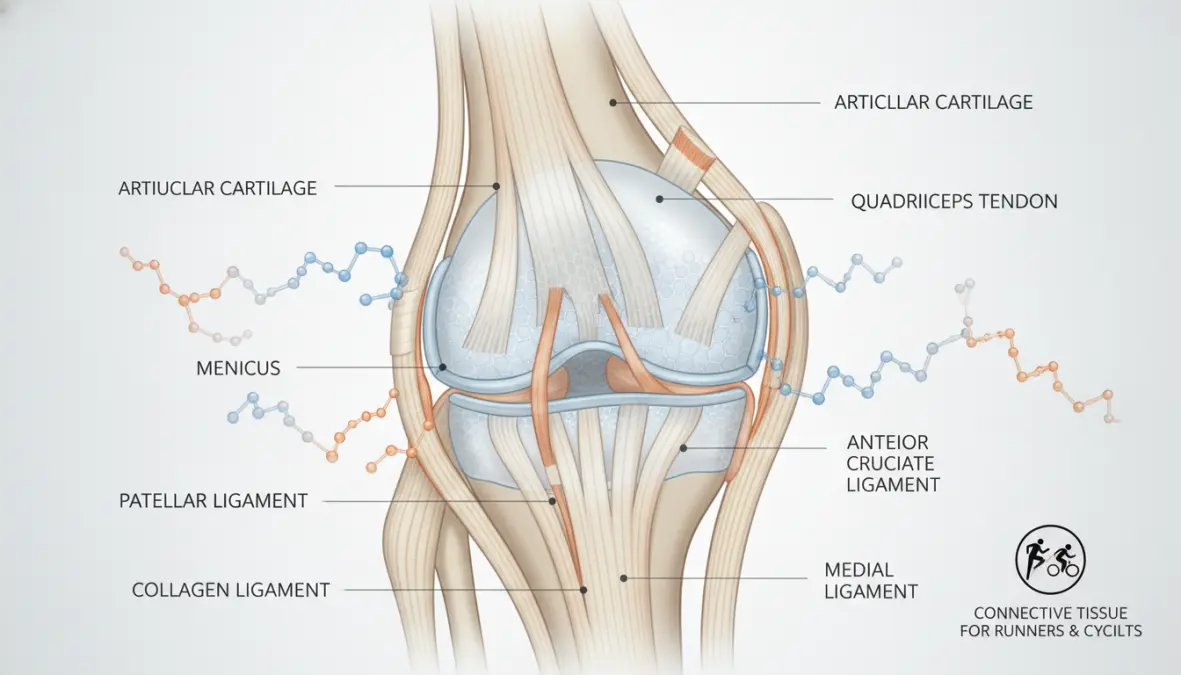
Collagen is the most abundant protein in your body, making up about 30% of total protein content. Think of it as the scaffolding that holds your connective tissues together—cartilage, tendons, ligaments, and even bone structure all rely heavily on collagen for their integrity and function. For collagen supplements endurance athletes, understanding this foundation is crucial because repetitive stress from running and cycling systematically breaks down these structures.
Here’s the reality: every foot strike while running generates impact forces of 2-3 times your body weight, transmitted directly through your ankles, knees, and hips. Cyclists may avoid that ground impact, but the repetitive flexion-extension pattern of pedaling—thousands of revolutions per ride—creates its own biomechanical stress on knee cartilage and surrounding connective tissue. Research shows that up to 50% of runners experience knee-related injuries annually, with patellofemoral pain syndrome and IT band issues topping the list.
As we age or accumulate training volume, natural collagen production decreases—dropping by about 1% per year after age 25. Combined with the mechanical stress of endurance training, this creates a perfect storm for joint inflammation, cartilage degradation, and chronic pain. This is precisely where strategic supplementation with collagen for joint health enters the conversation, potentially supporting the body’s repair processes and maintaining tissue resilience under athletic demands.
For athletes concerned about maintaining training consistency, addressing joint health proactively—through both supplementation and comprehensive prevention strategies like those outlined in our knee pain prevention guide—can be the difference between sustained performance and frustrating setbacks.
The Science Behind Collagen Supplements for Joint Health and Athletic Performance
So, do collagen supplements help joint pain in runners? The evidence is increasingly compelling. Collagen peptides athletes consume are hydrolyzed—meaning they’re broken down into smaller amino acid chains that your body can actually absorb and utilize. These peptides are rich in glycine, proline, and hydroxyproline—amino acids specifically needed for connective tissue support and new collagen synthesis.
Multiple clinical studies demonstrate measurable benefits. A landmark study published in the Journal of the International Society of Sports Nutrition found that athletes taking 10g of hydrolyzed collagen daily experienced significant reductions in joint pain during activity and at rest after 24 weeks. Another study focused specifically on knee pain showed that 5g of collagen peptides combined with vitamin C improved joint function and reduced collagen for knee pain symptoms in active individuals.
The mechanism goes beyond simply providing building blocks. When you consume collagen peptides, they trigger fibroblasts (the cells responsible for producing collagen) to increase their collagen synthesis activity. Research suggests timing matters: taking collagen 30-60 minutes before exercise may optimize this response, as the mechanical stimulus of training further signals your body to direct those amino acids toward cartilage repair and tendon health in the tissues under stress.
Regarding types: Type I collagen (most abundant in bones, tendons, ligaments) and Type II (primarily in cartilage) serve different functions. Most best collagen for joints supplements contain primarily Type I from bovine or marine sources, though some athletes benefit from Type II specifically for cartilage support. Type III often accompanies Type I and supports skin and blood vessel integrity. The question of collagen type 2 vs type 1 for athletes depends on your specific concern—Type II for cartilage-focused issues, Type I for broader connective tissue support.
Specific Benefits for Runners vs Cyclists
While both disciplines benefit from collagen supplementation, the specific advantages differ based on biomechanical demands. Collagen for runners primarily targets high-impact zones: the knees (patellofemoral joint, meniscus protection), ankles (Achilles tendon support), and even the plantar fascia. The repetitive ground strikes create microdamage that requires constant repair—precisely where collagen’s regenerative support becomes valuable.
Studies on distance runners show that collagen peptides for knee pain in runners can reduce pain intensity by 30-40% over 12 weeks, allowing for increased training volume without proportional increases in discomfort. The amino acid profile supports not just cartilage but the dense network of tendons and ligaments that stabilize the running stride.
Collagen for cyclists addresses a different pattern. While lacking ground impact, the repetitive knee flexion-extension through thousands of pedal strokes creates unique demands on the patellofemoral joint and surrounding structures. Cyclists often develop overuse issues in the patellar tendon and experience cartilage wear patterns specific to cycling mechanics. Collagen supplementation supports these tissues against repetitive strain, potentially improving resilience and reducing inflammation markers associated with chronic overuse.
Both groups benefit from improved recovery between sessions. Combining collagen with other recovery strategies—including proper nutrition covered in our anti-inflammatory foods guide—creates a comprehensive approach to maintaining joint health under high training loads.
What to Look for When Choosing Collagen Supplements
Not all collagen supplements are created equal, and choosing the best collagen supplements for cyclists joint health or runners requires understanding key quality markers. First, look for hydrolyzed collagen peptides—these have superior bioavailability compared to non-hydrolyzed forms or bone broth protein, which contains collagen but in less absorbable forms.
Source matters: bovine (grass-fed preferred), marine (from wild-caught fish), and chicken (particularly for Type II) each offer slightly different amino acid profiles. Bovine sources typically provide Types I and III, while marine sources offer highly bioavailable Type I. For targeted cartilage support, look for UC-II (undenatured Type II collagen) specifically.
Third-party testing certifications ensure purity and verify the absence of contaminants—especially important for athletes concerned about banned substances. Look for NSF Certified for Sport or Informed-Sport labels. The presence of Vitamin C (typically 50-100mg) is crucial since it’s required as a cofactor for collagen synthesis—glycine proline amino acids alone aren’t sufficient without this critical vitamin.
Regarding form, powders offer flexibility in dosing and easy mixing into smoothies or coffee, while capsules provide convenience. Optimal dosing for joint health benefits ranges from 10-15g daily for hydrolyzed peptides, or 40mg daily for UC-II. Some formulations combine collagen with glucosamine and chondroitin, which may offer synergistic benefits for osteoarthritis prevention and joint inflammation reduction.

How to Use Collagen Supplements for Maximum Joint Health Benefits
Understanding the optimal protocol separates those who see results from those left disappointed. For collagen supplements endurance athletes, the research-backed approach involves consistency, proper timing, and realistic expectations.
How much collagen should athletes take daily? The sweet spot appears to be 10-15g of hydrolyzed collagen peptides per day for joint health benefits. Some studies showing positive results used as little as 5g, but most robust effects appear at higher doses. Athletes dealing with active joint issues might benefit from the upper end of this range.
Timing significantly impacts effectiveness. The question of collagen supplements before or after running has a clear answer from recent research: taking collagen 30-60 minutes before training appears optimal. This timing allows the amino acids to be available in your bloodstream when mechanical loading signals your body to direct them toward tissue repair. Combining this with 50mg of Vitamin C enhances the effect.
When to take collagen supplements for joint recovery matters for consistency as well. Whether you choose pre-workout, with breakfast, or before bed, maintaining the same daily timing helps establish the routine. Many athletes find pre-workout most practical, while others prefer mixing it into morning coffee or a post-dinner routine.
Patience is essential. Most studies showing significant benefits for collagen supplements sports performance and joint pain reduction measured outcomes at 8-12 weeks minimum, with continued improvements up to 24 weeks. Don’t expect overnight miracles—collagen works by supporting your body’s natural repair processes, not by providing immediate pain relief like an anti-inflammatory medication.
Regarding safety, collagen supplements are generally well-tolerated with minimal side effects. Some people report mild digestive discomfort initially, which typically resolves. There’s no current evidence requiring cycling off collagen—continuous use appears safe and may be optimal for sustained benefits. However, athletes with specific dietary restrictions should verify the source aligns with their needs (marine for pescatarians, etc.).
Integration with your broader training approach amplifies benefits. Combine collagen supplementation with appropriate strength training—like the exercises in our core strength guide—to provide the mechanical stimulus that optimizes how your body utilizes those collagen building blocks.
FAQ: Collagen Supplements for Athletes
How long does it take for collagen to work for joint pain?
Most research shows measurable improvements beginning around 8-12 weeks of consistent supplementation at 10-15g daily. Some athletes report subtle changes earlier, but significant pain reduction and functional improvements typically require at least two months of consistent use.
Can collagen supplements prevent running injuries?
While no supplement guarantees injury prevention, collagen may reduce injury risk by supporting connective tissue resilience and reducing chronic joint inflammation. It works best as part of a comprehensive approach including proper training progression, adequate recovery, and addressing biomechanical issues.
Is collagen better than glucosamine for joint health?
They work through different mechanisms and aren’t necessarily competitors. Collagen provides amino acid building blocks for tissue repair, while glucosamine specifically supports cartilage matrix. Some evidence suggests collagen may be more effective for athletic populations, though combining both may offer synergistic benefits for certain individuals.
Do I need to cycle off collagen supplements?
Current evidence doesn’t suggest cycling is necessary. Collagen appears safe for continuous long-term use, and sustained supplementation may provide ongoing benefits for joint health and connective tissue maintenance, especially during high training volumes.
What’s the best time to take collagen for athletes?
Research suggests 30-60 minutes before training is optimal, as it provides amino acids during the mechanical stimulus that signals tissue repair. However, consistency matters more than perfect timing—choose a time you can maintain daily, whether pre-workout, with breakfast, or before bed.
The evidence supporting collagen supplementation for joint health in endurance athletes continues growing stronger. While it’s not a magic bullet that replaces proper training, recovery, and comprehensive injury prevention strategies, it represents a scientifically-supported tool for protecting the connective tissues that enable us to keep pursuing the miles we love. Combined with smart training progression, adequate nutrition including strategies from our protein nutrition guide, and attention to biomechanics, collagen supplementation can be a valuable component of your long-term joint health strategy. Your knees, ankles, and tendons put in the work mile after mile—giving them the nutritional support they need just makes sense.