Cycling Core Workout: Essential Plank Variations for Better Bike Stability
You might be crushing those climbs and hitting impressive wattage numbers, but if your core is weak, you’re literally leaving power on the table. A strong cycling core workout isn’t just about looking good off the bike—it’s the foundation that connects your upper and lower body, stabilizes your position during long rides, and ensures every ounce of effort actually reaches the pedals. And when it comes to building that rock-solid foundation, plank variations are your secret weapon.
Why Core Stability Matters for Cycling Performance
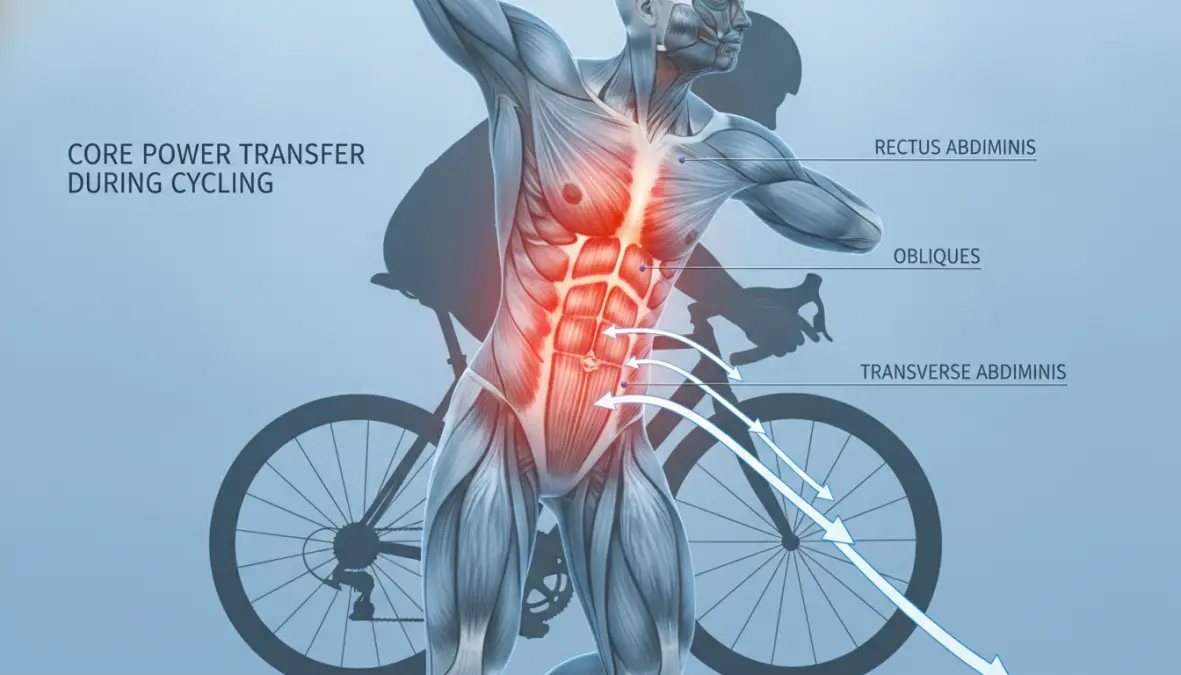
Let’s talk biomechanics for a second. When you’re pedaling, especially during hard efforts or climbs, your legs are generating massive forces. Without adequate core stability cycling, much of that power gets wasted through unnecessary upper body movement and postural compensation. Think of your core as the chassis of a race car—if it’s flexing and twisting with every input, you’re losing efficiency.
Research shows that cyclist core strength directly influences power transfer efficiency, with studies indicating that riders with stronger trunk stability can maintain higher power outputs with less energy expenditure. Your core acts as an anchor point, allowing your glutes and quads to push against a stable platform rather than a wobbly foundation. This becomes especially critical during out-of-the-saddle efforts, sprints, and technical descents where bike handling skills depend on your ability to stabilize the bike beneath you.
Beyond power output, proper trunk stability protects your lower back during those multi-hour rides. Cyclists commonly experience lumbar pain because weak cores force the lower back to compensate for lacking abdominal and oblique strength. Additionally, maintaining an aerodynamic position requires significant postural endurance—your core muscles must hold you in that tucked position for extended periods without fatiguing. Generic core exercises are fine, but bike-specific core exercises that mimic the demands of cycling position and movement patterns deliver far superior results. For more on building comprehensive strength, check out our guide on core strength exercises for endurance athletes.
Bike-Specific Plank Variations to Build Cyclist Core Strength
Now for the good stuff—the plank variations for cyclists that will transform your on-bike stability. These aren’t your standard gym-class planks; each variation targets specific weaknesses cyclists develop and addresses the unique demands of pedaling biomechanics.
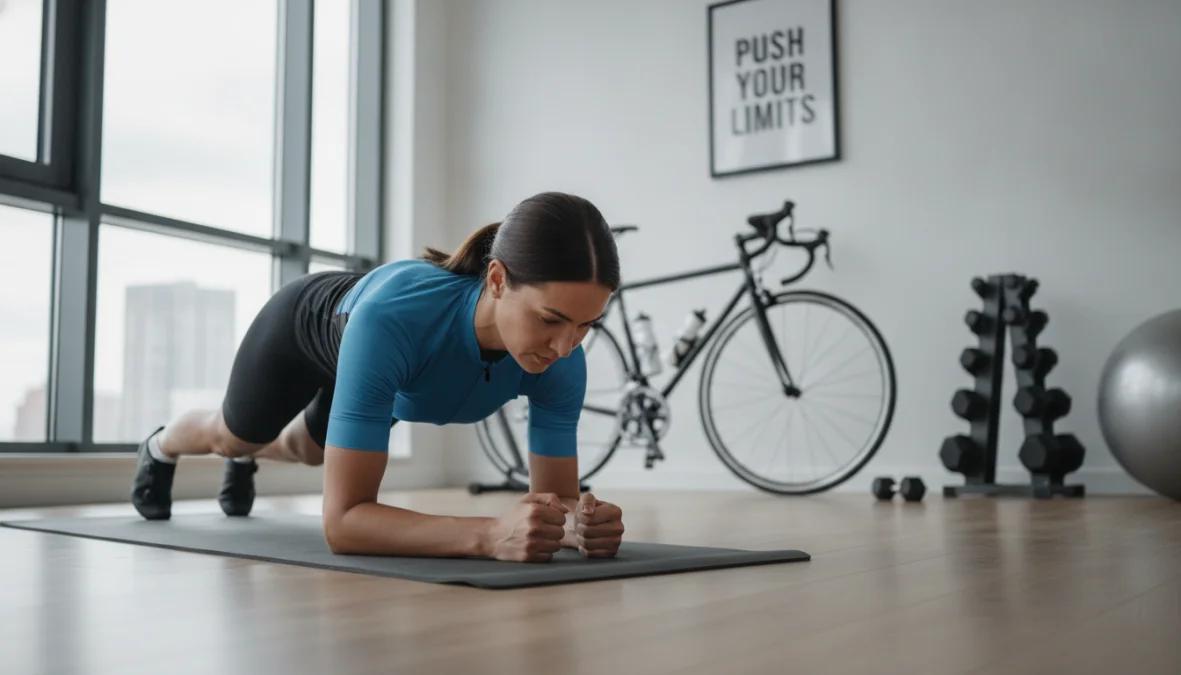
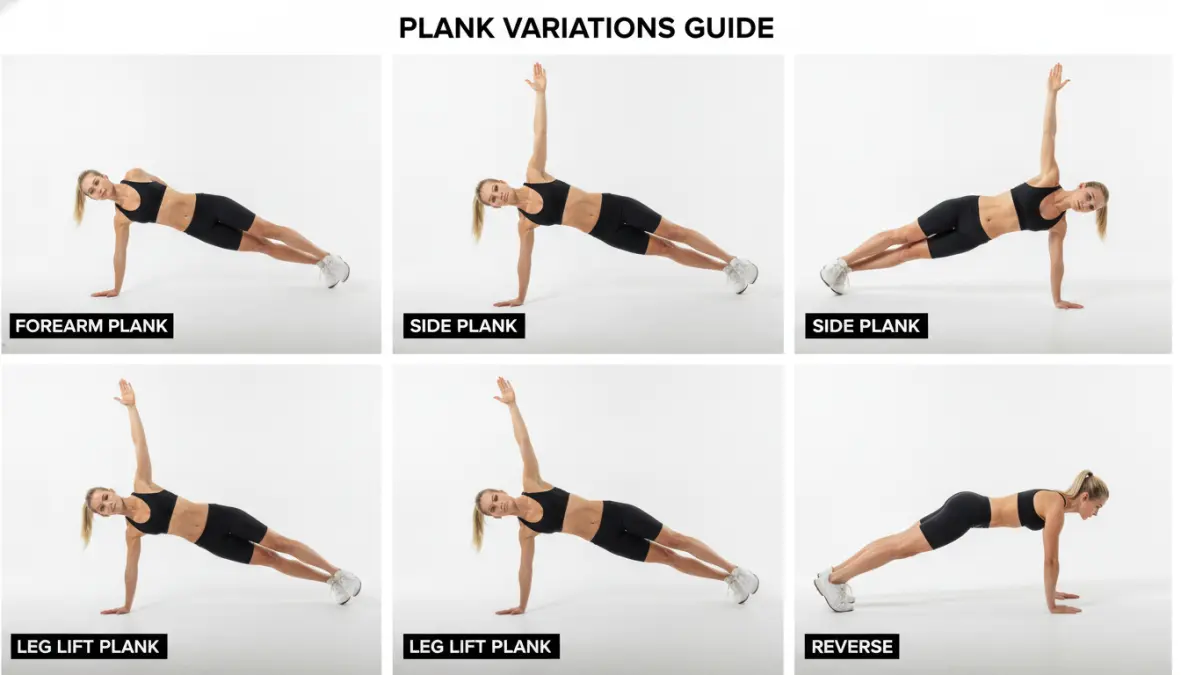
Standard Forearm Plank with Anti-Rotation Focus: Start with the classic, but with a cycling twist. Assume a forearm plank position, but instead of just holding static, focus on resisting rotation. Your goal is to maintain a perfectly neutral spine while imagining forces trying to twist you left and right—exactly what happens when you’re powering through pedal strokes. These anti-rotation exercises are crucial for pedaling efficiency. Hold for 30-60 seconds, focusing on quality over duration. Keep your glutes engaged and avoid letting your hips sag or pike upward.
Side Plank for Lateral Stability: Drop onto your forearm in a side plank position. This targets your obliques and quadratus lumborum—muscles essential for maintaining lateral stability when cornering or riding on uneven terrain. Cyclists often neglect lateral core strength, which compromises handling on technical descents. Hold 30-45 seconds per side, keeping your body in a straight line from head to feet. For an advanced variation, add hip dips or leg raises.
Plank with Alternating Leg Lift: From a standard plank, slowly lift one leg off the ground, holding it parallel to the floor for 3-5 seconds before switching. This mimics the single-leg loading pattern of pedaling and challenges your core to prevent rotation while one side is unsupported—exactly what happens during each pedal stroke. This is one of the best plank variations for cycling stability because it directly translates to on-bike movement. Perform 8-10 lifts per leg.
Plank with Alternating Arm Reach: Similar concept, different plane. From your plank, extend one arm forward as if reaching for something, hold for 3 seconds, then return and switch. This challenges your core to stabilize while your upper body loses a support point—critical for maintaining position during technical riding or when reaching for your water bottle. Complete 8-10 reaches per arm.
Copenhagen Plank for Adductor Strength: This advanced variation targets your hip adductors, which play a supporting role in pedaling biomechanics and knee tracking. Position yourself in a side plank with your top leg elevated on a bench or box, supporting your body weight through that elevated leg and your forearm. Your bottom leg hangs free. Hold for 20-30 seconds per side. This one burns but delivers serious results for lower body stability.
Reverse Plank: Sit with legs extended, place your hands behind you, and lift your hips to create a straight line from shoulders to heels. This targets your posterior chain—glutes, hamstrings, and lower back extensors—which often get overlooked in traditional core training for cyclists. These muscles are essential for maintaining position during long rides and preventing lower back fatigue. Hold for 30-45 seconds, focusing on squeezing your glutes and keeping your chest open.
Plank to Downward Dog: Start in a standard plank, then press your hips up and back into a downward dog yoga position, creating an inverted V-shape. This dynamic movement combines isometric core training with mobility work, addressing the hip and hamstring tightness many cyclists develop. It also challenges your core through different ranges of motion. Perform 10-12 controlled transitions, holding each position for 2-3 seconds.
Building Your Cycling Core Workout Routine
Having the exercises is one thing; knowing how to program them is another. A well-structured cycling plank workout should complement, not compete with, your bike training. Aim for 2-3 dedicated core sessions per week, ideally on days when you’re doing easier rides or rest days. Stacking intense core work after hard interval sessions is a recipe for diminishing returns and potential injury.
Each session should last 15-20 minutes, including a brief warm-up of dynamic stretches (leg swings, torso rotations, cat-cow stretches) and a cool-down with static stretching for hip flexors and lower back. Start with a cycling specific plank routine for beginners by performing 3 sets of each exercise with 30-45 second rests between sets. As you progress over 4-6 weeks, gradually increase hold times, add repetitions, or incorporate the more challenging variations.
Here’s a sample intermediate cycling core workout you can implement immediately:
- Warm-up: 5 minutes of dynamic stretching
- Standard plank with anti-rotation focus: 3 x 45 seconds
- Side plank (each side): 3 x 40 seconds
- Plank with alternating leg lift: 3 x 10 reps per leg
- Plank with alternating arm reach: 3 x 8 reps per arm
- Reverse plank: 3 x 35 seconds
- Plank to downward dog: 3 x 12 transitions
- Cool-down: 5 minutes of static stretching
Rest 30-45 seconds between sets, 60-90 seconds between exercises. For advanced plank variations for competitive cyclists, add the Copenhagen plank, increase hold times to 60+ seconds, or perform exercises on unstable surfaces like a BOSU ball. Remember to coordinate your core training for cyclists with your nutrition strategy—proper fueling supports recovery. Learn more about optimizing energy intake with our complete guide to carb cycling.
The key is consistency and progressive overload. Track your hold times and reps, aiming to improve slightly each week. As you build strength, you’ll notice improved comfort in the saddle, better aerodynamic position maintenance, and more explosive power during efforts. This foundation also supports your overall training progression, whether you’re following a spring cycling training plan or working on optimizing your cadence.
FAQ
How often should cyclists do planks?
Cyclists should perform plank-based core workouts 2-3 times per week for optimal results. This frequency allows adequate recovery between sessions while building progressive strength. Schedule these sessions on easy ride days or rest days to avoid interfering with high-intensity bike training. Consistency matters more than frequency—two quality sessions weekly beats sporadic harder efforts.
What’s the best plank for cycling?
The plank with alternating leg lift is arguably the best single exercise for cyclists because it mimics the unilateral loading pattern of pedaling while challenging anti-rotation stability. However, a comprehensive routine incorporating multiple variations—including side planks for lateral stability and reverse planks for posterior chain strength—delivers superior results to any single exercise.
Can core exercises improve cycling power?
Yes, absolutely. Studies demonstrate that improved core stability enhances power transfer efficiency by up to 5-8%, meaning more of your muscular effort reaches the pedals rather than being lost through postural compensation. Stronger cores also enable better positioning for aerodynamic gains and allow sustained higher power outputs during climbs and sprints by providing a stable platform for leg drive.
How long should cyclists hold a plank?
Beginners should start with 30-second holds, focusing on perfect form. Intermediate cyclists can target 45-60 seconds, while advanced riders may hold 60-90 seconds. However, quality trumps duration—a 45-second plank with perfect alignment beats a 90-second plank with sagging hips. When you can hold proper form beyond 90 seconds, progress to more challenging variations rather than simply extending time.
Your core is the unsung hero of cycling performance. While everyone obsesses over FTP numbers and lightweight components, the strongest riders know that stability, efficiency, and endurance all originate from a bulletproof midsection. Implement these plank variations for cyclists consistently, and you’ll discover watts you didn’t know you had—no expensive upgrades required. Now get off the bike and onto the mat; your next PR is waiting.