Running Form Analysis: Common Mistakes and How to Fix Them

Ever watched yourself run and thought, “Wait, is that really how I look?” You’re not alone. Most runners have no idea that their form might be holding them back—or worse, setting them up for injury. The good news? Once you understand what running form analysis reveals, you can make simple adjustments that transform your running experience completely.
Understanding Running Form Analysis and Why It Matters
Running form analysis is exactly what it sounds like: a systematic evaluation of how your body moves when you run. Think of it as a diagnostic tool that examines everything from how your foot strikes the ground to how your arms swing with each stride. And here’s why it matters: studies show that up to 79% of runners experience an injury each year, with many of these directly linked to poor running mechanics.
The benefits go beyond just injury prevention. Proper form means better energy efficiency—you’ll run faster and longer without burning out. You can conduct a running form analysis several ways: recording yourself on video and reviewing it in slow motion, working with a professional running coach, using specialized apps with AI analysis, or visiting a sports lab for comprehensive biomechanical testing. If you’re serious about performance optimization, combining running analysis with comprehensive performance testing gives you the complete picture of your athletic capabilities.
When should you get your form analyzed? If you’re dealing with recurring injuries, hitting a performance plateau, returning from a break, or just starting your running journey, it’s time. Even experienced runners benefit from periodic form checks—bad habits creep in over time.
The Most Common Running Form Mistakes
Let’s dive into the errors that trip up most runners. Recognizing these through running form analysis is the first step toward running smarter and safer.
Lower Body Form Errors
Overstriding tops the list of common mistakes. This happens when your foot lands too far in front of your body’s center of mass. How to spot it? Your heel hits the ground well ahead of your knee, creating a braking effect with each step. The consequences? Increased impact forces on your joints, wasted energy, and higher injury risk to knees, shins, and hips.
Heel striking isn’t inherently bad, but aggressive heel striking combined with overstriding creates problems. Your foot essentially acts as a brake, sending shock waves up through your leg. While some elite runners heel strike successfully, most recreational runners benefit from transitioning toward a midfoot or forefoot strike pattern that promotes smoother energy transfer.
Cadence problems often fly under the radar. Most runners shuffle along at 160-170 steps per minute when the optimal range is typically 170-180. Low cadence usually goes hand-in-hand with overstriding. Count your steps for 30 seconds and multiply by two—if you’re below 170, there’s room for improvement.
Poor knee drive means your knees don’t lift enough during the swing phase, resulting in a shuffling gait that limits power and speed. This mistake particularly affects your ability to run hills efficiently and sprint when needed.

Upper Body and Posture Issues
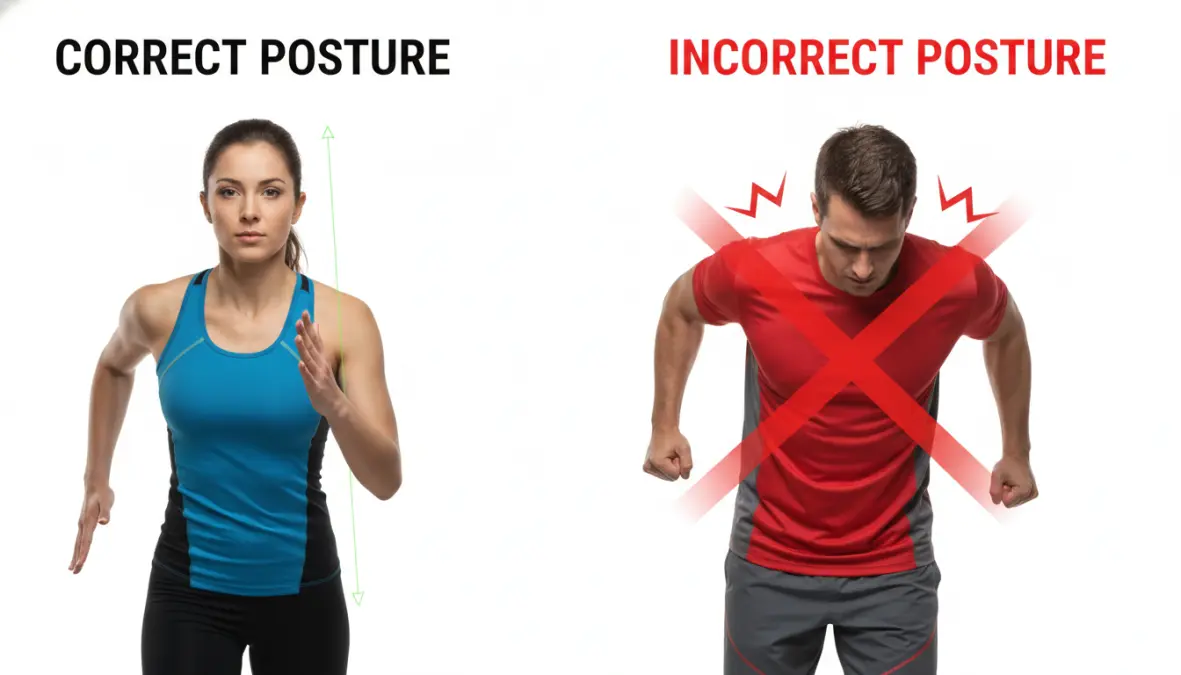
Don’t think running is all about the legs—your upper body plays a crucial role in efficiency. Poor posture shows up as slouching forward or leaning back excessively. The ideal? A slight forward lean from the ankles, not the waist, with your torso upright and stable. Slouching restricts breathing and creates unnecessary tension throughout your body.
Inefficient arm movement wastes energy you could channel into forward motion. Common errors include crossing your arms across your body’s midline, swinging them too high (above chest level), or keeping them too rigid. Your arms should swing naturally from the shoulders in a forward-backward motion, with elbows bent at roughly 90 degrees.
Tight shoulders creep upward toward your ears, especially when you’re tired. This tension cascades down, affecting your arm swing and overall efficiency. Looking down at the ground instead of ahead drops your head forward, throwing off your entire alignment. Your gaze should be about 10-20 feet ahead. Finally, excessive torso rotation turns running into a twisting motion that bleeds energy sideways instead of propelling you forward.
How to Fix Your Running Form: Practical Corrections
Identifying problems through running form analysis is step one; fixing them requires a strategic approach. Here’s how to actually make lasting changes to your running mechanics.
For overstriding, focus on increasing your cadence. Use a metronome app set to 170-180 beats per minute and match your footfalls to the rhythm. The mental cue “quick feet” helps. Try running in place, then slowly moving forward while maintaining that higher turnover—your stride will naturally shorten. Running drills like high knees and butt kicks teach your body proper leg positioning and improve neuromuscular coordination.
To address heel striking, don’t just try to land differently—that’s putting the cart before the horse. Instead, work on cadence first, and the foot strike often corrects itself. A-skips and short, quick hill sprints naturally encourage forefoot striking. Proper mobility work in your ankles and hips also facilitates better landing mechanics.
For posture issues, practice the mental cue of “running tall” with an imaginary string pulling you upward from the crown of your head. Core strengthening exercises off the track translate directly to better running posture. Film yourself regularly—even just using your phone propped against a tree—to check if improvements are sticking.
Fix arm swing by practicing the motion while standing still: elbows at 90 degrees, hands relaxed (imagine holding a potato chip without crushing it), swinging straight forward and back. During runs, periodically check in with yourself—shoulders relaxed? Arms swinging freely?
The golden rule: change one thing at a time. Trying to fix everything simultaneously overwhelms your nervous system and usually results in fixing nothing. Pick your biggest issue, work on it for 2-3 weeks, then move to the next. Remember that form changes take time—typically 4-6 weeks for new patterns to feel natural. And just like you wouldn’t ignore your body’s nutritional needs, don’t neglect the gradual process of biomechanical adaptation.
FAQ: Running Form Analysis
How often should I analyze my running form?
Every 3-4 months for regular runners, or whenever you’re dealing with persistent discomfort or performance plateaus. Quick video checks every few weeks help ensure you’re maintaining good habits.
Can I fix my running form on my own?
Absolutely! Many runners successfully improve their form using video self-analysis, online resources, and drill work. However, working with a qualified coach accelerates progress and catches issues you might miss.
How long does it take to correct running form?
Small adjustments might feel natural within 2-3 weeks, but significant biomechanical changes typically require 6-8 weeks of consistent practice. Patience pays off—rushing leads to injury.
What is the ideal cadence for runners?
Most experts recommend 170-180 steps per minute, though individual variation exists based on height, speed, and terrain. Focus on gradually increasing your current cadence by 5-10% rather than hitting a magic number.
Should I change my running form if I’m injury-free?
If it ain’t broke, be cautious about fixing it. That said, inefficient form might not hurt you now but could cause problems as mileage increases or age catches up. A professional assessment can identify potential issues before they become injuries.
Running form isn’t about achieving some perfect, one-size-fits-all technique. It’s about finding your most efficient, sustainable stride—one that keeps you healthy, fast, and loving every mile. Start with awareness, make gradual changes, and trust the process. Your future self will thank you when you’re still running strong years from now.