Plyometric Training for Cyclists: Build Explosive Power and Performance
You’ve probably spent countless hours perfecting your pedaling cadence and obsessing over your FTP numbers, but here’s something you might be missing: plyometric training for cyclists can unlock explosive power you didn’t know you had. When that rider attacks on the climb or when you need to respond to a sudden acceleration in the peloton, it’s not your steady-state endurance that saves you—it’s your ability to generate force fast. That’s where plyometrics come in, bridging the gap between what your legs can do over three hours and what they can do in three seconds.
Why Plyometric Training Transforms Cycling Performance
The connection between explosive strength cycling and real-world performance is backed by solid science. Plyometric training improves your neuromuscular system’s ability to recruit muscle fibers rapidly, enhancing what’s called the rate of force development—essentially how quickly you can generate power. For cyclists, this translates directly to better sprint performance, more powerful accelerations out of corners, and stronger efforts on steep gradients.
Here’s the thing about traditional strength training for cyclists: while heavy squats build maximum force capacity, they don’t necessarily teach your muscles to express that force quickly. Plyometrics fill this critical gap through the stretch-shortening cycle—a biomechanical phenomenon where muscles store elastic energy during a rapid lengthening phase and release it explosively during contraction. Think of it like a spring: the faster you compress it, the more powerfully it rebounds.
For plyometrics endurance athletes like cyclists, this training method offers unique benefits beyond what base miles alone provide. Research shows improvements in anaerobic capacity, enhanced pedaling efficiency through better muscle coordination, and increased power output without adding significant muscle bulk. Since cycling performance training demands both sustained endurance and explosive bursts, plyometrics develop that often-neglected fast-twitch capability that separates good riders from great ones.

Essential Plyometric Exercises for Cyclists
When it comes to plyometric exercises cycling specific, progression is everything. Here’s a structured approach to jump training cyclists can implement, organized by intensity level:
Low-Impact Foundation (Beginner Plyometric Workout for Cyclists):
- Squat Jumps: From a quarter-squat position, explode upward, landing softly with bent knees. This builds basic vertical jump power and trains the triple extension pattern crucial for powerful pedal strokes. Start with 3 sets of 6-8 reps.
- Lateral Jumps: Jump side-to-side over a low line or cone, emphasizing quick ground contact. Develops lateral stability and neuromuscular training for bike handling during sprints. Perform 3 sets of 10 reps per side.
- Pogo Jumps: Quick, ankle-dominant bounces focusing on minimal ground contact time. Enhances reactive strength and muscle recruitment patterns. Try 3 sets of 15-20 seconds.
Medium-Impact Development:
- Split Jumps: From a lunge position, jump explosively and switch legs mid-air. Mimics the alternating leg action of pedaling while building single-leg power. Complete 3 sets of 8-10 reps total.
- Single-Leg Hops: Horizontal hops on one leg, focusing on distance and controlled landings. Critical for developing the unilateral leg power cycling demands during out-of-saddle efforts. Do 3 sets of 5-6 hops per leg.
- Bounding: Exaggerated running strides emphasizing height and distance. Builds power endurance and dynamic coordination. Perform 3-4 sets of 20-30 meters.
High-Impact Advanced:
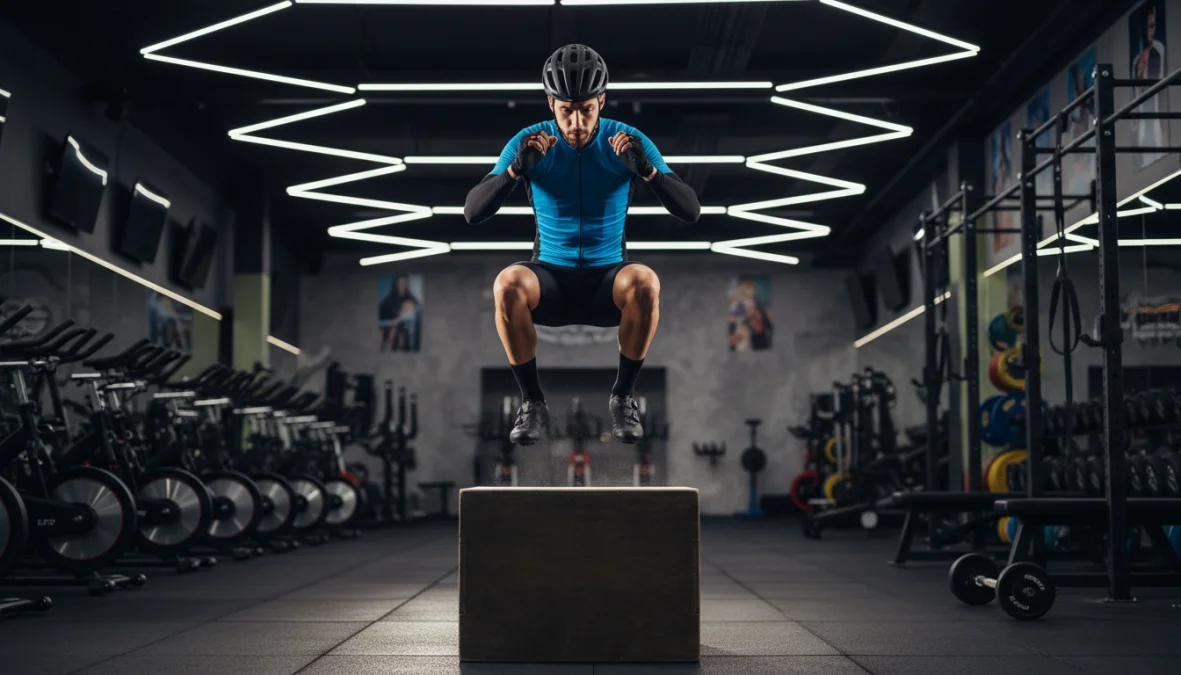
- Box Jumps: Jump onto a stable platform (start 12-18 inches), stepping down between reps. One of the best plyometric exercises for cyclists to develop maximum power output. Use 3-4 sets of 4-6 reps with full recovery.
- Depth Jumps: Step off a box (12-24 inches), land, and immediately jump vertically. Advanced exercise for elite rate of force development. Limit to 2-3 sets of 3-5 reps, only after mastering other progressions.
The key to understanding how to improve cycling power with plyometrics is recognizing the transfer effect: these exercises train your nervous system to recruit muscle fibers explosively, a pattern that directly applies when you stomp on the pedals during a critical climb or sprint finish.
Programming Plyometrics Into Your Cycling Training
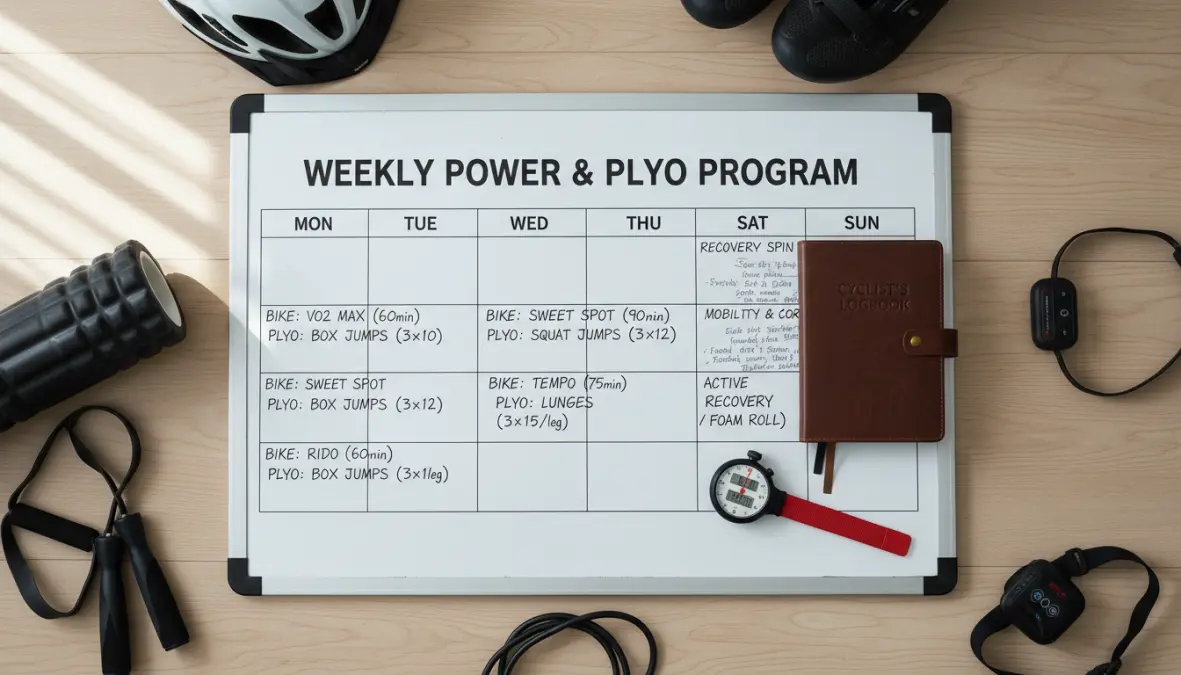
A proper plyometric training program for road cyclists requires strategic integration. The optimal frequency is 2-3 sessions weekly, with at least 48 hours between sessions to allow for neuromuscular recovery. Volume should be measured in ground contacts: beginners might start with 40-60 contacts per session, while advanced athletes can handle 80-120.
Timing matters enormously. The cycling off-season and early spring training phases are ideal for plyometric training cycling off season work when you’re building foundation fitness. During competition season, reduce volume but maintain 1-2 weekly sessions to preserve explosive capabilities.
Here’s a sample microcycle for intermediate cyclists:
- Monday: Easy endurance ride (60-90 min)
- Tuesday: Plyometric session (after thorough warmup, before any cycling)
- Wednesday: Rest or recovery spin
- Thursday: Interval training on bike
- Friday: Plyometric session (maintenance volume)
- Saturday: Long ride
- Sunday: Rest or easy recovery
Critical rule: always perform power training cyclists sessions when fresh, never after hard rides. Fatigue destroys the explosive quality that makes plyometrics effective and dramatically increases injury risk.
Safety Considerations and Common Mistakes
Before starting plyometric exercises to increase pedal power, you need a strength foundation. You should comfortably perform 10-12 single-leg squats with good form before progressing to high-impact plyometrics. This prerequisite prevents the most common injury: inadequate tissue resilience for explosive forces.
Always begin with a comprehensive dynamic warmup including leg swings, progressive hops, and mobility work. Land on appropriate surfaces—grass, rubber tracks, or specialized gym flooring—never concrete or hard pavement. Your knees should track over your toes, and landings should be soft and controlled, not stiff-legged.
Common mistakes include starting with excessive volume (the “more is better” trap), performing plyometrics with pre-fatigued legs, and poor landing mechanics. Endurance athletes accustomed to high training volumes often struggle with the concept that quality trumps quantity in explosive work. Remember: you’re training your nervous system, not grinding out endurance adaptations.
Watch for signs of overtraining: persistent joint soreness, declining jump height, or unusual fatigue. If you’re experiencing knee pain or other joint issues, address those before adding plyometric stress. These are common overtraining symptoms that shouldn’t be ignored.
FAQ: Plyometric Training for Cyclists
How often should cyclists do plyometric training?
Most cyclists benefit from 2-3 sessions weekly during off-season, reducing to 1-2 during competition phases. Each session should include 40-120 ground contacts depending on experience level, with at least 48 hours recovery between sessions to allow neuromuscular adaptation and prevent overtraining.
Can plyometrics improve climbing performance?
Absolutely. Plyometric training enhances your rate of force development and anaerobic capacity, both critical when attacking steep gradients or responding to accelerations on climbs. The explosive power you develop translates directly to more powerful out-of-saddle efforts and sustained high-intensity climbing.
Do plyometrics cause muscle bulk that slows cyclists?
No. Plyometric training primarily develops neuromuscular efficiency and explosive strength rather than hypertrophy. When programmed correctly with appropriate recovery, plyometrics improve power-to-weight ratio without significant muscle mass gains, making them ideal for cyclists concerned about maintaining optimal body composition.
What’s the best time of year for plyometric training?
The off-season and base-building phases are optimal for introducing or emphasizing plyometric work. This allows you to build explosive strength foundations when racing demands are lower. During competition season, maintain gains with reduced-volume sessions rather than starting new progressions.
How long before I see results from plyometric training?
Most cyclists notice improvements in sprint performance and acceleration within 4-6 weeks of consistent training. Measurable gains in power output and vertical jump typically appear after 8-12 weeks. The neuromuscular adaptations happen relatively quickly compared to endurance adaptations, making plyometrics an efficient training investment.
The bottom line? If you’re serious about cycling performance, plyometric training isn’t optional—it’s essential. Those explosive moments that define races, the attacks that stick, the sprints you win—they’re all built in the gym with strategic jump training. Start conservative, progress intelligently, and watch your power numbers transform along with your results on the road.