
Concurrent Training: How to Balance Strength and Endurance Work Without Compromise

You’ve probably heard the advice: “cardio kills gains.” But what if you want to be strong and have great endurance? Whether you’re training for a Spartan race, want to improve your overall fitness, or simply need both strength and cardiovascular capacity for your sport, concurrent training is the solution. The challenge? Doing it right without sabotaging one goal for the other. Let’s break down how to balance strength and cardio training without compromise.
What Is Concurrent Training and Why It Matters
Concurrent training is an approach that combines both strength and endurance training within the same program. Instead of focusing exclusively on lifting heavy or logging miles, you’re integrating both modalities to develop a more complete athletic profile. This hybrid training method has gained popularity among athletes, fitness enthusiasts, and everyday exercisers who want functional, real-world fitness.
Why does it matter? First, it’s efficient. Not everyone has time to dedicate separate training blocks to strength and endurance. Second, it reflects how we actually move in life and sport—most activities require both muscular strength and cardiovascular capacity. Think about carrying groceries up stairs, playing recreational sports, or even cycling, which benefits tremendously from added leg strength.
The benefits are compelling: improved overall fitness, better body composition, enhanced metabolic health, and greater functional capacity. However, there’s a catch called the interference effect—the phenomenon where endurance work can potentially compromise strength and muscle gains. Understanding and managing this interference is the key to successful combined training methods.
The Interference Effect: Understanding the Science Behind Concurrent Training
The interference effect describes how endurance training can blunt adaptations from resistance training, particularly for muscle hypertrophy and maximal strength. This isn’t just bro-science—it’s backed by solid research showing that combining high-volume cardio with strength work can reduce gains compared to strength training alone.
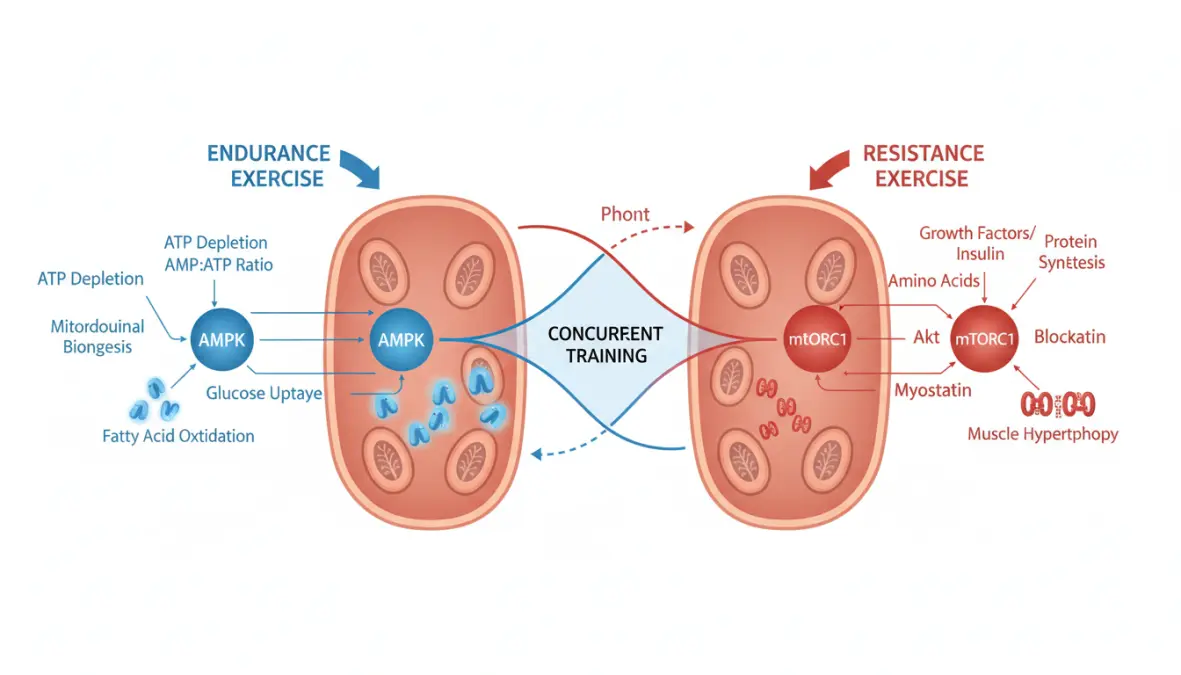
At the molecular level, this happens because different exercise types trigger competing cellular signals. Endurance work activates AMPK (AMP-activated protein kinase), which promotes mitochondrial development and fat oxidation. Resistance training, on the other hand, activates mTOR (mammalian target of rapamycin), which drives protein synthesis and muscle hypertrophy. When both pathways are activated simultaneously or in close succession, they can interfere with each other.
But here’s the good news: interference isn’t inevitable. Research shows that the magnitude of interference depends on several factors. Volume is critical—doing excessive cardio (think 60+ minutes daily) while trying to build strength creates significant interference. Intensity matters too: high-intensity interval training (HIIT) tends to interfere more with strength adaptations than low-intensity steady-state (LISS) cardio. The modality of cardio also plays a role—running creates more interference than cycling due to greater muscle damage and eccentric loading.
Timing between sessions is perhaps the most controllable factor. Doing cardio immediately before or after strength training increases interference. Ideally, you want at least 3-6 hours between sessions, or better yet, train them on separate days when possible. Poor recovery and inadequate nutrition amplify the problem, as your body lacks the resources to adapt to both stimuli. Strategic programming that respects these variables can minimize interference while maximizing endurance strength balance.

How to Design an Effective Concurrent Training Program
Now for the practical stuff. Designing a successful concurrent training program starts with prioritization. Ask yourself: what’s more important right now? If you’re primarily training for a marathon but want to maintain strength, endurance gets 60-70% of your focus. If you’re a powerlifter adding conditioning, strength takes priority. This clarity prevents the common mistake of trying to maximize both simultaneously.
For most people, 4-6 training sessions per week works well. A balanced approach might look like 3 strength sessions and 2-3 cardio sessions. An endurance-focused athlete might flip this to 2 strength and 3-4 cardio sessions. The key is managing total training volume—more isn’t always better, especially when you’re asking your body to adapt to competing demands.
Session timing is crucial. Same-day training is convenient but requires careful ordering. Generally, prioritize your primary goal first when you’re fresh. If strength is priority, lift weights first, then do cardio. If training separately, morning strength and evening cardio (or vice versa) works well, providing that 6+ hour recovery window. Proper nutrition between sessions becomes essential here.
Choose your cardio wisely. For the best way to combine strength and endurance, low-impact options like cycling, rowing, or swimming create less interference than running. If you’re wondering does cardio interfere with strength gains, the answer depends largely on what type—two LISS cycling sessions weekly will barely impact strength, while daily hard runs will. Cycling offers particular advantages for concurrent training.
Periodization is your secret weapon. Rather than hammering both modalities year-round, cycle your emphasis. Spend 4-8 weeks emphasizing strength (3-4 strength days, 1-2 easy cardio), then shift to an endurance focus (2 strength maintenance sessions, 3-4 cardio). This block periodization allows genuine adaptation without chronic interference. For a concurrent training program for beginners, start conservatively—2 strength days and 2 moderate cardio days—then build from there.
Programming Variables and Practical Guidelines
Let’s get specific with a concurrent training workout schedule. For strength sessions, work in the 70-85% 1RM range for 3-5 sets of 4-8 reps on compound movements. Keep sessions focused—45-60 minutes maximum. For cardio, 20-45 minutes is the sweet spot. Longer sessions increase interference risk unless endurance is your primary goal.
Recovery between same-day sessions matters enormously. Minimum 3 hours, ideally 6+ hours. If you must train back-to-back, at least separate upper and lower body work (upper body strength, then running works better than leg day followed by a run). Watch for overtraining signs like persistent fatigue, declining performance, mood changes, or elevated resting heart rate—addressing these early prevents serious setbacks.
Nutrition becomes non-negotiable. You need adequate protein (1.6-2.2g per kg bodyweight), sufficient carbohydrates to fuel both modalities (4-7g per kg depending on volume), and proper meal timing. Hydration also plays a crucial role in recovery and performance optimization.
Common Mistakes to Avoid
The biggest mistake? Excessive total volume. Adding cardio on top of an already high-volume strength program is a recipe for stagnation. Solution: reduce strength volume slightly (fewer sets per exercise) when adding endurance work. Inadequate recovery is closely related—respect rest days and sleep 7-9 hours nightly.
Many people fail to prioritize objectives, trying to maximize everything simultaneously. Pick your primary goal for each training block. Doing high-intensity cardio before strength training tanks your lifting performance—if you must do both same-day, save intense cardio for after weights or do it separately. Ignoring progressive overload in favor of random “functional” workouts prevents real adaptation. And finally, undereating for the training volume attempted will guarantee poor results in both domains.

FAQ: Concurrent Training Questions Answered
Can you build muscle while doing cardio? Absolutely. Moderate cardio (2-3 sessions weekly, 20-40 minutes) won’t significantly impact muscle growth, especially when nutrition and recovery are dialed in. Keep cardio intensity moderate and prioritize strength training for muscle-building goals.
Should I do cardio before or after strength training? Generally, after. Doing cardio first depletes glycogen and creates fatigue that compromises lifting performance. If your primary goal is strength or muscle hypertrophy, always lift first. For endurance athletes, the reverse applies.
How much cardio is too much when strength training? It depends on intensity and modality, but as a rule, more than 45-60 minutes of moderate cardio daily or multiple high-intensity sessions weekly will likely create significant interference. If strength is your goal, cap cardio at 2-3 sessions of 30-40 minutes.
What type of cardio interferes least with strength gains? Low-intensity cycling, rowing, or swimming cause minimal interference. These create less muscle damage than running and don’t tax the same movement patterns as squats and deadlifts. LISS cardio interferes less than HIIT when strength is the priority.
Is concurrent training suitable for beginners? Yes, but start conservatively. Beginners adapt well to multiple stimuli and won’t experience significant interference with moderate volumes. Begin with 2-3 strength sessions and 2 cardio sessions weekly, focusing on technique and gradual progression. Consider functional training approaches that naturally blend strength and conditioning.
Training for both strength and endurance simultaneously isn’t easy, but it’s absolutely achievable with smart programming. The key is respecting the science of the interference effect while strategically manipulating volume, intensity, timing, and recovery. Whether you’re building cycling fitness or developing general athleticism, concurrent training offers a path to complete fitness. Start with clear priorities, monitor your recovery, and adjust based on performance. Your body is remarkably adaptable—give it the right signals, and you can absolutely have your strength and endurance too.